
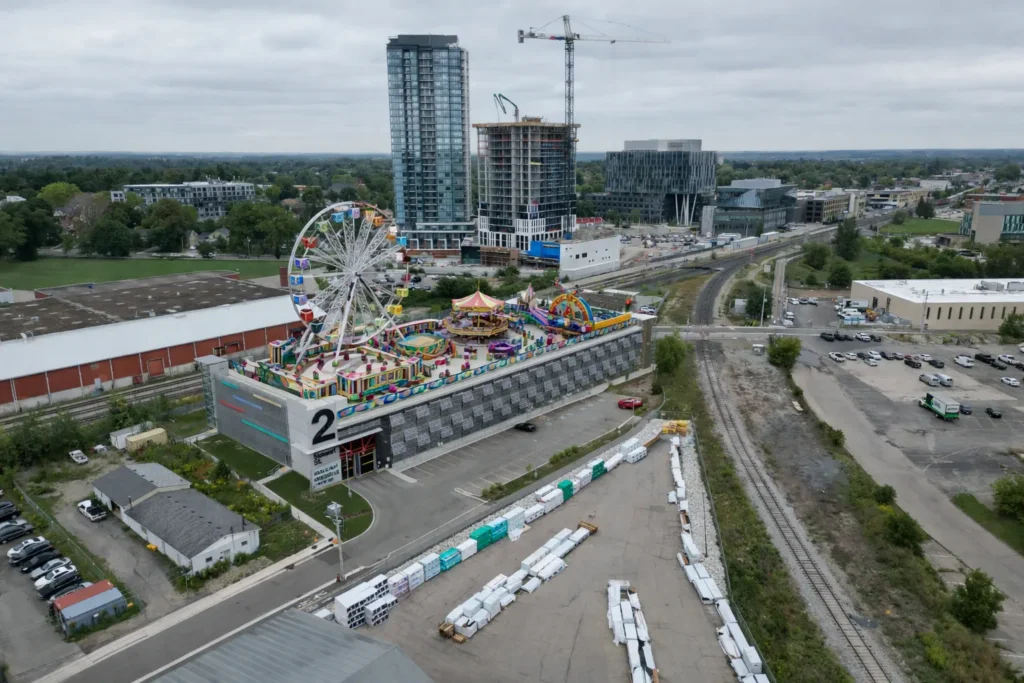
Yes, you can build on top of a parking structure.
The bigger question is what does that choice do to the cost, design, and building code rules for your project.
This article focuses on above grade, stand alone parking structures, not underground garages.
When you add other uses on top of an above grade stand alone parkade, you can lose the simple open-air design that makes it affordable in the first place.
How open-air parking structures keep costs low
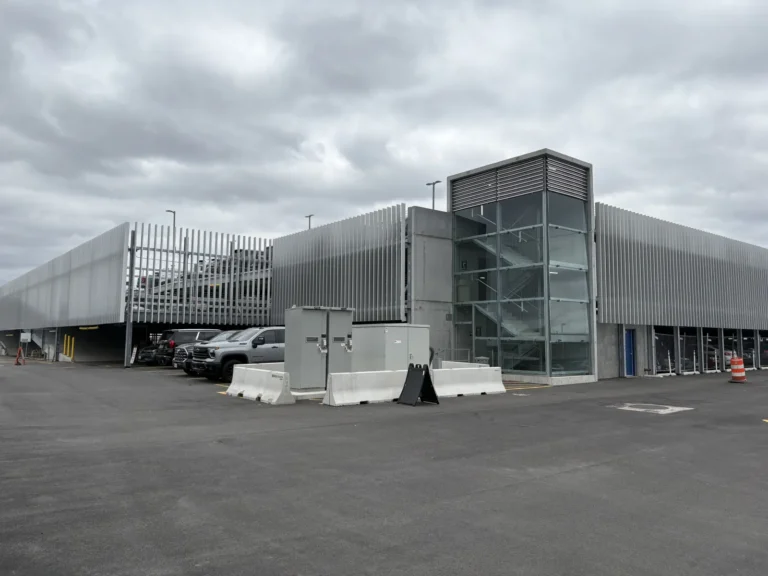
Many above grade parkades in Canada are designed as open-air parking structures.
They are not just garages without walls, they are a special type of building in the code.
In simple terms, an open-air structure:
- Uses non-combustible construction
- Has lots of openings around the outside so fresh air can flow through
- Is limited in height and floor area
- Does not need large mechanical ventilation systems
Because of this, open-air parking structures can avoid many costly systems, such as:
- Extra fireproofing spray on beams and columns
- Large HVAC systems to move air
- Some fire alarm components
- Some standpipes and sprinklers, depending on height and local rules
This is why open-air parking structure construction is usually much cheaper than building a fully enclosed parking garage.
If you want to learn more about how these work, you can read our article on open-air parking structures.

How building on top changes the rules and the cost
In the building code, every part of a building has a use-case. The technical word for this is occupancy, but we can think of it as what people do in the space.
Examples include:
- Parking as one type of occupancy
- Homes as another
- Offices, restaurants, gyms, day cares, and sports courts as others
Here is the key idea.
When you stack different uses on top of each other, the stricter use often controls the rules for the entire building.
If you start with an open-air parking structure, then add something like a tennis court or restaurant on top, the code may say it is no longer just an open-air storage garage.
It may now be an assembly or residential occupancy, and the whole building may need to be enclosed and meet those higher standards.
That can mean:
- More fireproofing and fire separations
- More exits and stairs
- Full mechanical ventilation and HVAC
- More complex sprinklers and alarms
- Stiffer requirements for vibration
- More structure to support added loads
The added weight isn’t really the issue. The structure can be designed as an open-air structure and be able to accommodate the extra weight. The changes are mainly due to fire rating requirements, HVAC and plumbing requirements, sprinklers, and vibration requirements and others.
Enclosed type structures are often about double the cost of open-air structures to construct.

A simple cost example
Let’s use rough numbers to show what happens when you change the use on top of a parking structure.
Imagine an 8 storey open-air parking structure.
- Each level has about 80 cars
- Each level is about 24,000 square feet
- Total area is about 192,000 square feet
If it stays as an open-air structure, the cost might be around $100 to $150 dollars per square foot. That means the total structure could cost roughly $19.2 million to $28.8 million dollars.
Now imagine you add a tennis court on the roof.
If that tennis court means the whole building is now treated as an enclosed assembly occupancy, the cost might jump to $200 to $300 dollars per square foot. The same 192,000 square feet could now cost about $38.4 million to $57.6 million dollars.
That is before you add the cost of building the tennis court level itself.
So you need to ask a hard question.
Is that tennis court, park, or restaurant on top really worth many extra millions of dollars?
You also need to remember that zoning and local bylaws matter.
Some sites will not allow certain uses at all, or only in certain locations or heights, so you should always check with local planning and building departments early.

Can you build a park on top of a parking structure?
If it is an open-air structure, no. You can add a roof, but you cannot add anything that would change the use-case.
You can build a park on top of a parking structure, but it will remove the open-air status making your entire project significantly more expensive (see example above).
Many cities like rooftop parks because they add green space in dense areas.
They can also make a project feel more welcoming and attractive.
But a park is usually treated as an assembly use in the code.
Soil, trees, planters, and people all add extra considerations, so the project must be designed for that from day one.
You also need very good waterproofing so water does not leak into the parking levels below.
On top of that, you may lose your open-air classification and end up with an enclosed, higher cost building.
In many cases, a better option is to keep your open-air parking structure as parking and put the park at ground level beside it or on a separate structure.
Fire rated walls and proper separation can let each part of the project follow the right rules without driving up the cost of the entire parking structure.
Can you build a restaurant on top of a parking structure?
For open-air parking structures, no you can’t.
You can build a restaurant on top of a parking structure, but it changes how the building code treats the entire building, and the whole structure will now be roughly double the cost.
This is common in urban areas where space is tight and views are valuable.
Rooftop restaurants can feel exciting, but they bring extra complexity.
Restaurants have kitchens, grease, higher fire risks, and more plumbing and mechanical systems.
The building code normally treats a restaurant as an assembly occupancy.
When you put that on top of a parkade, it can change the whole building to that stricter standard.
That can require more exits, more fire separations, and more structure.
It can also trigger full mechanical ventilation for the parking levels below.
The simple open-air model can disappear, along with its cost savings.
If you are early in planning, one smart approach is to place the restaurant at grade beside the garage.
You can connect it with walkways or small bridges and keep the parking as an open-air parking structure that stays simpler and lower cost.
Designing this together with a design-build construction team can help you see these tradeoffs clearly.
Can you build residential on top of a parking structure?
If you want the benefits of an open-air structure, the answer is no, not easily.
You can build residential on top of a parking structure, but it usually turns the whole project into a more complex building type. This might be worth the cost, however it is important to understand how this will impact the project cost.
Many mixed-use projects with homes and parking stack these uses.
It can be a good way to use land in busy urban areas.
Residential use is one of the strictest occupancies in the code.
It often requires higher fire ratings, more sound insulation, and strong envelope performance.
When you stack homes on top of what started as a simple open-air garage, the parking levels may now be treated as part of a residential building, not just parking.
That often means an enclosed structure with higher costs per square foot.
In some cases, a better idea is to design both together from day one using systems like the Kiwi Precast System for the building and the Kiwi CarPark System for modular parking structures.
The key is to choose a structure type that matches your long term plan, not bolt homes on top later as an afterthought.
Can you build offices on top of a parking structure?
Can you build it on top of an open-air parking structure? No.
You can build offices on top of a parking structure, but you lose the open-air benefits that kept the parking affordable, and the structure would be required to meet the demands of an occupancy type building code classification.
This can be a good way to use land in busy commercial areas.
Employees can park and walk straight into their workplace.
Offices are often less demanding than homes but still stricter than simple parking.
They may require more HVAC, more glazing, and higher performance building envelopes.
Again, the pattern is the same.
An open-air parking structure on its own is cheaper, but adding offices on top can change the entire building to a more complex, more expensive type.
If you think an office tower might be part of your future plan, it is important to design the parking structure construction with that in mind from the start.
Retrofitting a basic parkade to support offices later can be very costly.

Can you build a daycare on top of a parking structure?
If it is an open-air structure, no.
You can build a daycare on top of a parking structure, but it is one of the most sensitive and tightly controlled uses.
A day care involves young children and strict rules about safety.
Daycares usually need strong fire separations, safe exits, and outdoor play spaces that meet clear standards.
Putting a daycare on top of a parkade often means the whole building will be treated as a higher risk occupancy.
You will need strong separation between cars and children, and you may have to enclose what would otherwise be a simple open-air garage.
In many communities, planning staff may also be cautious about a daycare over traffic and exhaust.
This may affect whether it is approved at all.
You will need to check zoning and bylaws very early in the process.
This helps you avoid spending time on a layout that local rules will not support.
Can you build pickleball courts on top of a parking structure?
If it is an open-air structure, no.
You can build pickleball courts on top of a parking structure, but it will change how the code treats the entire building.
Pickleball has become very popular, and rooftop courts can look like a smart use of space. They can bring people and activity to the roof.
Pickleball courts are lighter than full buildings, but they still count as an assembly use because many people gather there.
Courts add live loads and sometimes fencing, small shelters, and lighting.
The building code may treat the top level as an assembly area, which can again impact the whole building.
This brings us back to the cost example where turning your 8 storey open-air garage into an enclosed assembly building might double the overall cost.
You need to weigh that extra cost against the benefit of having courts on the roof instead of on the ground or nearby land.

Can you build tennis courts on top of a parking structure?
If it is an open-air structure, no.
You can build tennis courts on top of a parking structure, but they come with higher cost and more complex design rules.
Tennis courts are similar to pickleball courts but often larger and heavier.
They may involve higher fences, taller lighting, and sometimes seating or small stands for spectators.
From a building code view, this is again an assembly occupancy.
If you add tennis courts on top, the whole structure may need to meet assembly rules.
Your open-air parking structure may now become an enclosed, more costly building.
Your cost per square foot may jump from something like $100 – $150 dollars to $200 – $300 dollars, across every level.
That is why the question is not just whether you can build tennis courts on top of a parking structure, but whether that is the best way to spend your budget.
Can you add a roof or solar panels to a parking structure?

Adding a roof can be a very smart upgrade! You can often do this while still keeping the benefits of an open-air parking structure, as long as the sides stay open for natural ventilation.
A roof on the top deck can improve the user experience right away.
It reduces snow, rain, and ice buildup and makes the top level more comfortable for drivers and pedestrians.
This can also cut down on de-icing salt and plowing needs.
That can lower long term maintenance costs and help extend the life of the structure.
Many owners also choose to mount solar panels on the roof structure (or as the roof structure).
Parking structures have large elevated areas that are perfect for solar panels. Unlike other buildings types, parking structures don’t have various mechanical units or roof penetrations that create shadowing for a solar array. This makes them a perfect place to put solar panels.
In this case, the roof does two jobs at once by protecting vehicles and generating electricity for the site.
Solar panels on a parking structure roof can:
- Provide shade and weather protection for cars and people
- Generate clean electricity on a large, unused surface
- Support energy and sustainability goals for the property
If you are thinking about solar panels on a parking structure, it is best to plan them from day one if possible.
This lets the engineer size the structure for the extra loads and integrate wiring, inverters, and other equipment neatly.
Even on existing garages, a well designed roof with solar panels can often be added after careful review of the original design.
The key is to confirm that the structure can safely support the extra weight and wind loads.
A full roof that starts to close in the sides is different.
Once you significantly enclose the perimeter, the structure may no longer qualify as open-air and could be treated as an enclosed garage instead.
That shift can bring higher costs for ventilation, fire protection, and other systems.
So a light, open roof with solar panels is usually the best path if you want weather protection and energy generation while keeping open-air status.
If you want to explore power generation further, you can also look at our work with solar power systems.


So, Can You Build on top of a parking structure wisely?
Can you build on top of a parking structure? Yes. But should you build on top of a parking structure?
With enough money and manpower you can build many things on top of a parking structure, including parks, restaurants, homes, offices, daycares, pickleball courts, and tennis courts.
The key is to remember that the building code looks at the whole building, not just one level.
Adding a different use on top can change the rules for the entire structure and can double the cost of your parking, not just the cost of the new level.
Zoning and local bylaws also shape what is allowed, where, and how tall.
In many projects, the smartest move is to keep the parking as an open-air parking structure using systems like the Kiwi CarPark System and place parks, courts, or buildings beside it, or design everything together from the start.
When you understand how the rules affect cost, you can spend money where it makes the most impact for your users and your community.