
TL;DR: Steel beams in parking structures deserve more attention in durability discussions. In many conventional cast-in-place and double-tee garages, a large amount of critical steel sits buried inside concrete where deterioration can be harder to assess directly. A system that uses hot-dip galvanized steel framing with dense UHPC deck panels changes that risk profile by protecting the steel, reducing chloride pathways at the top surface, and making the primary flexural members visible and inspectable over time.
When engineers discuss steel beams in parking structures, the conversation often gets reduced to steel versus concrete. That is too simplistic. The better question is this: where is the critical tension steel, how well is it protected, and how easy is it to inspect after years of water, chlorides, freeze-thaw cycles, and traffic wear?
That is where parking structure durability gets interesting. In a parking garage, the exposed driving surface takes the abuse. Water and de-icing salts hit the top surface first, not the underside of the structure.
If that top surface cracks in the wrong places, chloride intrusion in concrete becomes a long-term structural problem. If the steel that matters most is hidden inside the concrete, condition assessment becomes harder, more reactive, and more disruptive.
In parking structures, long-term durability is not only about material strength. It is also about whether the critical load-carrying steel remains protected, visible, and inspectable over time.
Why steel beams in parking structures deserve a different durability discussion
Engineers generally prefer ductile flexural behavior over brittle behavior. A healthy reinforced concrete flexural member can provide warning through cracking, yielding, and deformation before ultimate failure.
That basic idea matters even more in parking garages, because the structure lives in a harsh environment year after year. Water, chlorides, freeze-thaw cycling, and traffic wear all work on the same system.
In many conventional cast-in-place and double-tee garages, the primary tension steel is embedded inside the concrete. There is a lot of steel in those systems. You just do not see it, and that is the problem.
ACI guidance on durable parking structures makes clear that parking structures face durability demands that are different from many other buildings. ACI guidance on reinforcing steel corrosion also makes clear that corrosion is not just a strength-loss issue. It is also a condition-evaluation and maintenance issue.
That is what makes hidden rebar corrosion such a difficult long-term risk to manage. The concern is not just the steel itself. It is the uncertainty that comes with not being able to see the condition of the primary tension reinforcement directly.

The real exposure zone is the top driving surface
Many durability discussions focus on the material in the abstract. Parking garages do not deteriorate in the abstract. They deteriorate where water, salts, abrasion, and repeated wetting actually occur.
That means the exposed top surface matters most. Top surface cracking in parking decks is where many future repair campaigns begin.
In conventional continuous concrete slabs and many double-tee systems, negative moment cracking can develop over supports. That puts the exposed top surface in tension at exactly the location where water and chlorides can enter.
Once that happens, reinforced concrete parking garage deterioration can accelerate. The top surface cracks, chlorides move inward, reinforcing steel begins to corrode, and the visible symptoms often show up later as rust staining, delamination, or spalling.
By the time those symptoms are obvious, the internal steel may already have lost area, bond, or anchorage. That is one reason parking structure rehabilitation can become so disruptive and expensive.

What corrosion does to hidden rebar
Rebar corrosion in parking garages does not usually announce itself with a dramatic moment. It tends to work slowly in the background while the structure keeps doing its job.
That is what makes it so challenging. Corrosion can reduce steel area, weaken bond, damage anchorage, crack the cover concrete, and chip away at the reserve ductility built into the system.
A concrete garage can still perform well for a long time when it is detailed properly and maintained properly. But once corrosion starts advancing inside the section, the flexural behavior becomes less predictable and the warning signs become harder to read with confidence.
That is the real durability problem. In many conventional garages, the critical tension steel sits inside a chloride-exposed concrete system where deterioration can be hard to observe directly.
Why this matters for lifecycle planning
- Condition assessment often relies on indirect signs, testing, or selective demolition.
- Repair scopes can grow after opening the structure and finding more damage.
- Parking garage maintenance becomes less predictable.
- Owners face higher risk of major rehabilitation instead of targeted intervention.
For municipalities, universities, airports, hospitals, and long-term property owners, that matters. Parking structure lifecycle cost is not just about first cost. It is also about inspectability, repair timing, and how much operational disruption a future repair campaign creates.
Inspectable steel framing changes the discussion
This is where inspectable steel framing has a real advantage. If the primary flexural members are visible, corrosion is easier to detect, section loss is easier to monitor, and repairs can be more targeted.
That does not mean exposed steel is immune to corrosion. It means the deterioration mode is more transparent.
In practical terms, galvanized steel beams and columns can be inspected directly throughout the service life of the structure. That supports better structural inspectability, better maintenance planning, and better asset management.
This is one reason the case for galvanized steel for parking structure construction is stronger than a simple materials preference. It is a durability strategy.

Why hot-dip galvanizing matters
A hot-dip galvanized steel parking structure is not just a steel frame with a coating. Hot-dip galvanizing creates a bonded zinc layer that delays corrosion in chloride-exposed conditions while keeping the primary steel members visible and accessible for inspection.
That combination is what makes it powerful. The structure is not only protected. It is also easier to understand and manage over time.
From an engineering and ownership perspective, hot-dip galvanizing helps in three ways:
- It delays the onset of corrosion in a salted, wet-dry exposure environment.
- It supports proactive maintenance before section loss becomes severe.
- It keeps the primary tension-resisting members visible instead of burying them inside the deck.
If localized damage occurs, the affected area can often be identified and addressed long before it becomes a major structural issue. That is a very different risk profile from hidden reinforcement inside a deteriorating slab or tee.
For engineers who want to go deeper into inspection logic, AISC discusses ultrasonic thickness measurement as one way to assess steel thickness loss relative to nominal section thickness.
The deck strategy matters just as much as the steel
The Kiwi approach is not simply steel beams with concrete on top. It is a system-level durability strategy.
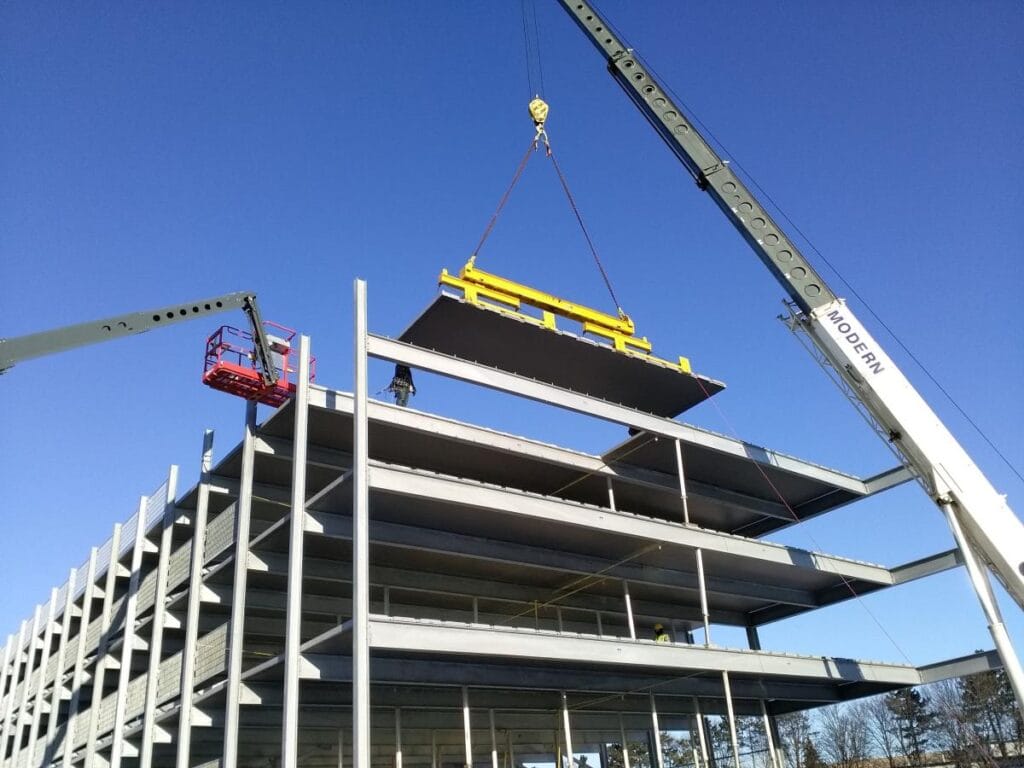
In the Kiwi CarPark System, precast high-performance or UHPC deck panels span between hot-dip galvanized steel beams. The goal is to reduce the likelihood of durability-critical cracking at the exposed top surface.
That is important because the top surface is where parking garage corrosion problems often start. If that surface stays largely in compression under normal service conditions, the system can reduce one of the most common pathways for chloride intrusion in concrete.
This is the key distinction. The bottom of the deck may still see flexural tension between supports. But the exposed top surface, where water and salts sit, is the more important durability face.
That is one reason UHPC for parking structures is worth serious attention. FHWA has noted that UHPC-class materials offer very low permeability and very good resistance to freeze-thaw damage, which helps reduce contaminant ingress and improve long-term durability.
No concrete deck is completely free from cracking risk. Shrinkage, temperature effects, joints, detailing, and local actions still matter.
Even so, this approach can avoid one of the most damaging global distress mechanisms in conventional decks, namely negative moment cracking at the exposed top surface over supports.

Concrete parking systems still have a place
Concrete parking systems can absolutely be durable when the structural system, detailing, materials, protection strategy, and maintenance program are done well.
The point of this article is not that concrete is bad. The point is that hidden steel creates a very different maintenance and inspection challenge than visible steel.
Many cast-in-place and double tee parking systems rely on embedded reinforcement inside a chloride-exposed concrete assembly. Once deterioration begins, engineers and owners often have to work harder to find the damage, confirm the extent of it, and price repairs with confidence.
That is a big reason why parking structure durability should be discussed as a service-life and asset-management issue, not just a materials issue.
Steel beams in parking structures and long-term owner value
For many owners, this discussion comes down to a simple question. What kind of deterioration would you rather manage 20 years from now?
Would you rather deal with hidden reinforcement inside a deck that may require sounding, selective demolition, membrane replacement, and broad repair zones? Or would you rather inspect visible galvanized steel beams and columns, monitor their condition directly, and target repairs where they are actually needed?
That is why steel beams in parking structures can offer a compelling durability advantage when paired with the right deck system. The best results come from combining inspectable steel framing, hot-dip galvanizing, dense deck materials, and controlled top-surface behavior.
It is also why system choice should happen early. Decisions made at concept stage will affect not only structure and schedule, but also decades of inspection access, maintenance risk, and future rehabilitation cost.
If you are comparing options for a new parkade, it helps to look beyond first cost and study the full durability strategy. Start with the exposed top surface. Then ask where the critical steel is, how it is protected, and how easy it will be to inspect when the structure is no longer new.
For more on planning and system selection, see 30 things to know before building a parking structure, open-air parking structures, and how much it costs to build a parking structure.
Key Takeaways
- Parking garage durability starts at the exposed top driving surface.
- Negative moment cracking over supports can create direct chloride pathways in conventional concrete systems.
- Hidden rebar corrosion can reduce steel area, bond, anchorage, and reserve ductility over time.
- Cast-in-place and double-tee garages often contain a lot of steel, but much of it is hidden inside the concrete.
- Inspectable steel framing makes corrosion easier to detect, assess, and manage.
- Hot-dip galvanized steel parking structure systems improve corrosion protection while preserving inspection access.
- Dense UHPC deck panels can reduce permeability and help limit chloride ingress.
- For owners, the real value is not only structural performance. It is lower uncertainty in parking garage maintenance and future rehabilitation.