
Canada’s latest airport investment announcement raises questions for airport authorities, operators and infrastructure planners. On September 15, 2026, the federal government announced that it would seek private investment through long-term concessions to operate Canada’s four largest airports while retaining public ownership of the underlying land and assets. It also described an intention to reinvest capital raised into infrastructure, including regional airports and local transportation connections. The announcement did not approve any specific parking garage, establish a parking construction grant or commit a defined budget to new parking spaces.
For an airport considering additional parking, the announcement is a reason to review its long-term infrastructure plans, not to assume a new source of funding is available. A defensible parking investment still needs evidence of demand, a clear financial and operational case, a realistic delivery strategy and an agreed approval process.
What did Canada’s September 2026 airport announcement actually propose?
In remarks at the Canada Investment Summit, the Prime Minister said the federal government would seek private investment through long-term concessions to operate the four largest airports. The accompanying government news release says the government intends to work with airport authorities and other stakeholders, including airlines and local governments, while retaining ownership of the underlying airport land and assets. It describes proposed reinvestment in regional airports, local transport and other national infrastructure.
The Canadian Airports Council identifies the four airports as Toronto Pearson, Montréal-Trudeau, Calgary and Vancouver. The council has called for any new investment model to address national connectivity, airport infrastructure and affordability. Those are the council’s stated priorities, not settled terms of a concession agreement.
At the time of this article’s preparation, the cited announcement does not provide airport-specific parking projects, concession contracts, a parking procurement schedule or a dedicated parking funding allocation. Details of how any future agreement would affect capital approvals, operating responsibilities and individual facilities would need to be confirmed as the proposal develops.
Does this mean an airport parking garage has new government funding?
No parking funding should be assumed from this announcement alone. The proposal concerns potential private investment in airport operations and possible reinvestment of proceeds in wider infrastructure. It is not a notice that parking projects at the four airports—or at regional airports—have been authorized.
Airport owners should also avoid confusing the announcement with existing programs. Transport Canada’s Airports Capital Assistance Program is a separate, eligibility-restricted program directed toward safety-related projects at qualifying airports. Its published guidance generally excludes non-safety facility expansion. An ordinary parking-capacity project should not be described as eligible without an explicit program-specific determination.
For a board, capital-planning committee or potential development partner, the appropriate starting assumption is straightforward: identify the funding source and approval authority for the proposed parking investment before building it into a financial plan.
First, determine whether the airport needs more parking capacity
Passenger growth does not automatically translate into an equivalent increase in required parking stalls. Demand depends on how people reach the airport, the mix of passengers and employees, length of stay, pricing, airline schedules and competing ground-transportation services. An airport may have a shortage at one location or time of day while capacity elsewhere remains underused.
Before selecting a garage footprint or target stall count, assemble a parking demand profile that distinguishes:
- Peak occupancy: where and when spaces are full, including seasonal peaks and irregular travel periods.
- Customer groups: short-stay passengers, long-stay passengers, employees, rental-car operations and other authorized users.
- Length of stay and turnover: how long vehicles occupy each facility, not only how many enter.
- Location and access: walking distance, shuttle travel time, accessibility, congestion and the actual convenience of alternative lots.
- Temporary capacity losses: stalls removed by nearby construction, maintenance, terminal changes or a future parking project itself.
- Reasonable demand scenarios: a range of passenger, employee and transportation outcomes rather than a single growth assumption.
The result should be a location-specific capacity requirement with an explanation of the operating problem it solves. A proposed 500-stall addition is not a complete business case unless an owner can show why those stalls are needed, where they belong and how they will be used.
Compare a new parking structure with other capacity and access options
New structured parking may be appropriate when land is limited, surface lots are full or convenient access carries a meaningful operational value. But it should be compared against realistic alternatives before the project is defined.
Possible alternatives include improved wayfinding and real-time occupancy information, revised allocation between employee and passenger parking, operational changes to underused lots, shuttle improvements, better curbside management or use of additional surface land where available. Changes in transit connections and ground transportation may also influence long-term demand.
Each option has trade-offs. Remote parking may require dependable shuttle capacity and operating expenditure. Better information will not fix a genuine shortage of physical spaces. A new garage may preserve land for other airport uses but introduce construction, maintenance and access obligations.
Compare the options using the same demand assumptions and a consistent scope boundary. That helps distinguish an immediate operational fix from a long-term capital investment.
Build a complete parking business case—not just a cost per stall
The structure itself is only part of an airport parking project. Early estimating should include site preparation, geotechnical and foundation requirements, utility conflicts, drainage, access roads, connections to terminals or shuttle stops, elevators and stairs, lighting, security, accessible routes, signage and any relevant technology systems.
Operating and lifecycle costs matter as well: maintenance, winter service where applicable, inspection, renewal, insurance, staffing, shuttles and future repair requirements. The owner should distinguish construction cost, overall project capital cost, financing cost and operating cost so that alternatives can be compared fairly.
Revenue scenarios deserve similar discipline. Model occupancy, rates, operating expenses and financing under more than one demand case rather than assuming every added stall will be occupied at a chosen price. If parking is being evaluated alongside terminal, roadway or transit upgrades, the business case should explain how those investments interact.
For a general discussion of scope and estimating, see Kiwi Newton’s parking structure cost guide. Any historical cost-per-stall figures need to be checked against the actual project, location, specifications and current market before being used in a budget.
Plan construction around an airport that must remain operational
Airport parking is not built on an empty site with no consequences for surrounding activity. Construction can affect passenger routes, employee access, shuttle operations, deliveries, service roads and existing stalls. Airport security, restricted areas and airside or landside operating rules also shape construction access.
Before selecting a construction approach, identify how the airport will function during each stage:
- Map the spaces and access routes that cannot be taken out of service at the same time.
- Set temporary parking, shuttle and pedestrian arrangements before the first closure.
- Determine delivery routes, crane and equipment locations, worker access and safe separation from the public.
- Coordinate utility shutdowns, inspections and other airport-controlled activities with operations personnel.
- Define which portions of a new facility can be opened independently, subject to approvals, and how the next stage will proceed.
A phased plan should be assessed against the net spaces available throughout construction, not only the finished stall count. An aggressive construction schedule that removes too much existing capacity may create an operating problem even if it shortens the nominal build period.
Kiwi’s separate guide to airport parking garage construction covers the broader facility-design considerations. This article focuses specifically on the investment decision and how it intersects with operational continuity.
Consider the site, building method and future flexibility together
An above-grade parking structure, a surface-lot expansion or another configuration should be tested against the actual airport footprint, available land, geotechnical conditions, height constraints, access and long-term master plan. Existing utilities and nearby infrastructure can influence both the cost and feasible foundation arrangement.
When a structured solution is justified, the construction-method assessment should compare viable alternatives on a complete-system basis. Cast-in-place concrete, conventional precast and prefabricated panel-and-beam solutions have different implications for design, component production, transport, erection, durability and maintenance. There is no universal method that will be the least expensive or fastest at every airport.
Future flexibility also deserves explicit consideration. Is the facility intended to remain for decades? Could terminal expansion require the land? Might demand move to another part of the site? A relocatable or demountable concept can be evaluated where a credible future relocation or repurposing requirement exists, but dismantling, transport, foundations and reuse must be engineered and budgeted rather than assumed to be simple.
The owner should compare the life of the proposed facility with the airport’s land-use strategy before committing to a permanent layout. See Kiwi’s overview of temporary and relocatable parking structures for the distinction between temporary use and genuine design for disassembly and reuse.
How would a new investment or operating model affect procurement?
The September announcement does not establish the project-level procurement rules for a future parking garage. Before initiating design, an airport should determine which organization would be the project sponsor, who controls the land and budget, who must approve the scope, and who will operate and maintain the completed facility. Any concession documentation, existing agreements and applicable procurement requirements would need review as they become available.
The capital plan should also identify the appropriate decision gates: initial demand evidence, preliminary scope and budget, business-case approval, delivery-method selection and authorization to proceed. Airport authorities, operators, government stakeholders and private partners may have different responsibilities depending on the actual structure of a project; the announcement alone does not resolve them.
Design-Build is one delivery option that brings design and construction responsibility together and allows estimating and constructability input during design. For an airport managing phasing and complex operational interfaces, early involvement can help test the proposed budget and construction sequence before drawings are finalized. It does not automatically guarantee savings, supersede required competitive procurement or remove airport-specific approvals. The delivery model must fit the owner’s governance and risk allocation.
What does airport parking experience look like in practice?
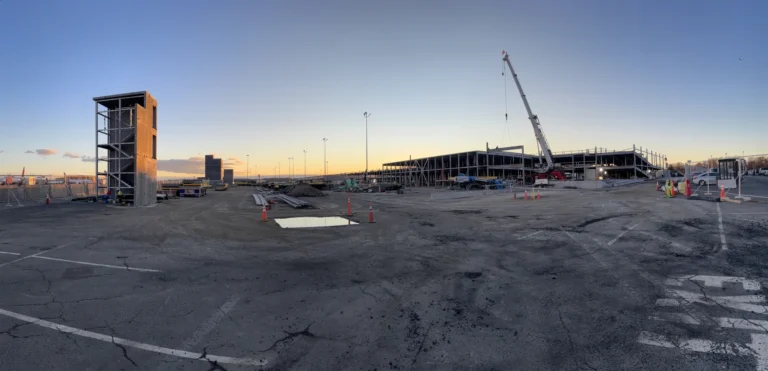
Kiwi Newton’s Ronald Reagan Washington National Airport Relocatable Parking Deck in Virginia is an example of airport-specific Design-Build planning. Kiwi’s published project profile describes a demountable parking structure and a phased approach intended to maintain available parking while sections are constructed. The project profile currently lists the work as in progress. It is a United States project, not a Canadian parking project financed under the September 2026 announcement.
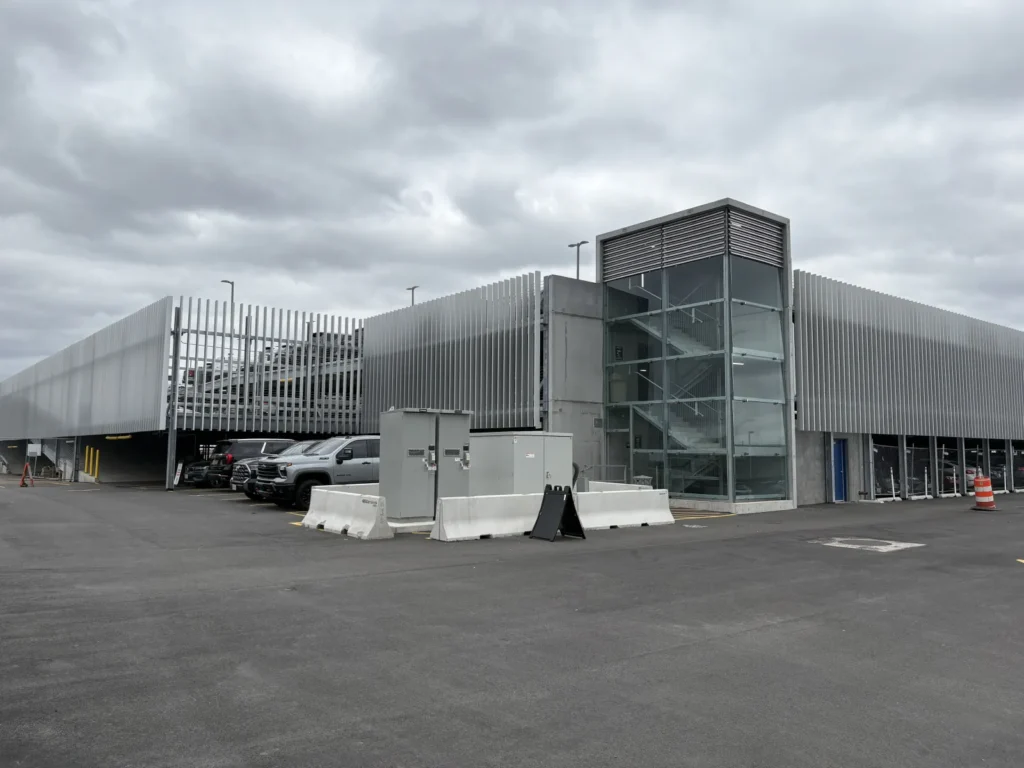
In Canada, Kiwi’s Sioux Lookout Municipal Airport Parking Structure is a separate Design-Build project, also listed as in progress. Its published design provides for future expansion. It offers a regional-airport example of planning parking capacity alongside operational and climate requirements; its funding should not be inferred from the new federal concession proposal.
These examples illustrate different planning questions—phasing at an active airport and designing for future capacity—not a promise that every airport needs the same construction system or delivery schedule.
Seven questions airport owners should answer before authorizing an expansion
- What measured demand shows the additional stalls are necessary, and in which locations?
- What operational, pricing, shuttle or surface-parking alternatives have been evaluated?
- What is the complete capital and lifecycle cost, including supporting access and utilities?
- How will passenger and employee parking function during every construction phase?
- How does the facility fit terminal development, transport connections and future land use?
- Who owns the business case, budget, procurement decision and operating responsibilities?
- What funding is actually confirmed, and what assumptions depend on a future policy or concession agreement?
These questions can turn a broad discussion about investment into a defined, testable infrastructure project. They also help an owner avoid locking in a stall count or construction method before the operational case is clear.
Planning an airport parking investment?
Canada’s airport investment proposal may evolve, but the underlying parking decision remains project-specific: establish demand, compare alternatives, confirm funding and procurement, then develop a realistic scope, budget and phasing plan. Treat announcements as policy context rather than project approval.
Explore Kiwi Newton’s parking structure Design-Build services or contact Kiwi Newton to discuss capacity, site conditions, budget and operational requirements at your airport.
Sources and publication note
- Prime Minister of Canada: Canada Investment Summit opening remarks, September 15, 2026.
- Prime Minister of Canada: Canada Investment Summit news release, September 15, 2026.
- Canadian Airports Council: response to the proposed airport investment model, September 15, 2026.
- Transport Canada: Airports Capital Assistance Program eligibility and restrictions.
Policy information reviewed September 17, 2026. The proposed concession arrangements, funding mechanisms and project approvals may change. The announcement does not itself authorize or fund a parking structure; check current official decisions and project-specific requirements before committing capital. Featured image: an existing conceptual rendering associated with Kiwi Newton’s Ronald Reagan Washington National Airport project in the United States, not a rendering of a Canadian airport expansion.