

TLDR: A successful stadium parking structure is not just about adding more stalls. It must support game day traffic flow, pedestrian safety, accessibility, security, tailgating, long-term durability, and efficient construction around an active stadium site.
Stadium parking structure design and construction is very different from building a standard parking garage. A stadium parking structure has to handle thousands of people arriving before a fixed start time, then leaving in a short window after the event.
That makes stadium parking a transportation problem, a safety problem, a fan experience problem, and a construction problem all at once.
Why Stadium Parking Structures Are Different
Most parking garages deal with steady demand. Office garages fill in the morning and empty in the evening. Retail parking turns over throughout the day.
Stadiums are different.
Before a game, concert, or major event, many drivers arrive at roughly the same time. After the event, thousands of people walk back to their vehicles and try to leave at once.
This creates pressure on every part of the system:
- Roads leading to the stadium
- Parking structure entrances
- Payment or access control points
- Internal ramps and drive aisles
- Stairs, elevators, and pedestrian exits
- Nearby intersections after the event
For this reason, stadium parking structure design and construction should start with one simple question:
How do we move vehicles and people safely before and after the event?
Stall count matters, but throughput matters more. A garage with enough spaces can still fail if cars cannot enter, park, and exit efficiently.
Stadium Parking Structure Design and Construction Starts With Access, Process, and Park
The Federal Highway Administration describes event parking in three parts: access, process, and park. Access means getting vehicles from the street network into the parking area. Process means handling payment, permits, scanning, or approvals. Park means moving vehicles from the access point to an actual parking space.
You can read more about this framework in the FHWA’s planned special events parking guidance.
This is a useful way to think about stadium parking garage design.
Access
Access is about how vehicles reach the parking structure. Poor access design can push congestion back onto public roads.
Important questions include:
- How many approach routes feed the garage?
- Can traffic be split by permit type, entrance, or parking zone?
- Are left turns creating bottlenecks?
- Is there enough queue storage before the entry gates?
- Can traffic control staff manage the site during major events?
Process
Processing is where many stadium parking plans break down. If drivers have to stop for payment, scanning, or instructions, the entry rate slows down.
For stadium parking planning, consider:
- Prepaid parking passes
- License plate recognition
- Separate VIP, staff, media, and general public lanes
- Clear signage before drivers reach the gate
- Enough space for attendants without blocking traffic
Park
Parking is the internal movement inside the garage. Drivers should understand where to go without hesitation.
Good stadium parking design should include:
- Simple ramp layouts
- Clear level identification
- Few decision points
- Open sightlines
- Visible stairs and elevators
- Easy access back to the stadium pedestrian route
Game Day Parking Design Is About Ingress and Egress
Ingress means arrival. Egress means departure.
Both matter, but they behave differently.
Before the event, people arrive over a wider window. Some arrive early for tailgating. Others arrive just before kickoff or start time.
After the event, demand is more compressed. A large share of fans may try to leave within the first 30 to 60 minutes.
That is why parking structure ingress and egress should be designed as separate operating modes.
Pre-Event Ingress
During arrival, the structure needs to absorb vehicles quickly and distribute them through the garage. The goal is to prevent lines from backing onto surrounding roads.
Design considerations include:
- Multiple entrances where the site allows
- Separate access points for different user groups
- Simple internal circulation
- Clear entry signage before decision points
- Prepaid or permit-based processing
- Room for queuing on site
Post-Event Egress
After the event, the garage needs to empty efficiently. This can be more difficult than arrival because pedestrians and vehicles are moving at the same time.
Design considerations include:
- Multiple exit lanes
- Exit routes that connect cleanly to arterial roads
- Temporary traffic control plans
- Pedestrian crossings that do not block garage exits
- Lighting and visibility at all conflict points
- Clear routing for rideshare, buses, and shuttles
For stadium traffic management, the garage should be part of the larger event plan. The structure, road network, police control, shuttle routes, and pedestrian paths all need to work together.
Pedestrian Flow May Be the Most Important Design Issue
Stadium pedestrian flow is often the most overlooked part of parking garage construction for stadiums. The garage may work well for cars, but fail for people.
After a major event, thousands of pedestrians may walk toward the garage at once. Some are families. Some are elderly. Some use wheelchairs, walkers, strollers, or mobility devices.
The pedestrian route should be obvious, wide, direct, and protected from vehicle conflicts.
The FHWA also provides guidance on pedestrian access planning for special events, including the need to coordinate walking routes with parking areas, transit stops, and pick-up or drop-off zones.
Good Pedestrian Design Includes
- Stair towers facing the natural walking route to the stadium
- Elevators close to accessible parking areas
- Wide pedestrian exits from the garage
- Protected crossings at garage driveways
- Clear signage from the stadium back to the garage
- Bright lighting for night events
- Enough queuing space at elevators and stairs
A stadium parking garage should feel like an extension of the event site. Fans should not have to guess where to walk.
Tailgating Changes the Parking Strategy
Stadium parking is not always just about parking. At many stadiums, the parking area is part of the event.
Tailgating can shape the whole site plan.
This is one reason stadiums are different from urban arenas. Stadiums often have more land, more surface parking, and more pre-game activity.
Before replacing surface lots with structured parking, owners should ask:
- Is tailgating part of the fan culture?
- Do fans expect surface parking?
- Are RVs, buses, and oversized vehicles common?
- Are grills, tents, waste stations, or washrooms needed?
- Should the garage free up land for a better tailgate zone?
In some cases, structured parking for stadiums should not replace all surface parking. It may work better as part of a blended strategy.
For example, a stadium may keep some surface areas for tailgating and use a parking structure to increase capacity on a smaller footprint.
Surface Parking vs Structured Parking for Stadiums
Surface parking is simple and familiar. It can also support tailgating, buses, RVs, and large outdoor gathering areas.
On the other hand, surface parking uses a lot of land.
A stadium surrounded by asphalt can limit future development. It can also create long walking distances, poor stormwater performance, and a weak connection to the surrounding district.
A stadium parking structure can help solve some of these issues.
Structured Parking Can Help Stadium Owners
- Fit more vehicles on less land
- Free land for plazas, retail, hotels, housing, or green space
- Improve pedestrian routes to the stadium
- Support a more compact stadium district
- Reduce the amount of surface asphalt on the site
- Create parking that can be used on non-event days
This does not mean every stadium needs a large new garage. It means stadium parking land use planning should compare the value of land, event operations, fan experience, and long-term site flexibility.
Accessible Stadium Parking Needs More Than Code Minimums
Accessible stadium parking must be planned as a complete route, not just a set of stalls. The route from the vehicle to the stadium entrance matters.
ADA.gov explains that accessible parking spaces in lots or garages must be located on the shortest accessible route to the accessible entrance. You can review the requirements on the ADA accessible parking spaces page.
For stadiums, this is especially important because crowds are large and post-event movement is intense.
Accessible Parking Considerations
- Accessible stalls near elevators
- Van-accessible clearance
- Level, slip-resistant surfaces
- Clear signage
- Weather-protected routes where possible
- Elevator capacity after the event
- Accessible drop-off and pick-up areas
- Routes that avoid vehicle conflicts
Accessible stadium parking should be easy to use during the busiest part of the day. If it only works during quiet conditions, it has not been fully planned.
Stadium Parking Safety and Security
Stadium parking safety is about more than lighting. It includes visibility, pedestrian separation, traffic control, emergency access, and security planning.
Good parking structure design can reduce confusion and help people feel more comfortable.
Important safety features include:
- Open sightlines across parking levels
- Bright, consistent lighting
- Visible stairs and elevator lobbies
- Clear wayfinding
- Camera coverage
- Emergency phones or communication points
- Pedestrian paths separated from drive aisles
- Logical layouts that reduce driver hesitation
This is where CPTED parking garage design matters. CPTED stands for Crime Prevention Through Environmental Design.
The goal is to use design to improve visibility, reduce hidden spaces, define public and private areas, and make the structure easier to monitor.
The Whole Building Design Guide also notes that structured parking should consider safety, security, visibility, durable materials, pedestrian access, and long-term maintenance.
Open-Span Parking Structures and Stadium User Experience
An open-span parking structure can be especially useful for stadium parking. Fewer interior columns can improve sightlines, lighting, camera visibility, and driver comfort.
It can also make the garage easier to understand.
This matters because many stadium visitors are not daily users. They may only visit the site a few times per year.
A confusing garage can slow traffic and create stress. An intuitive garage helps drivers make decisions quickly.
For stadium parking structure design and construction, open sightlines support several goals:
- Better visibility for drivers
- Fewer hidden areas
- Improved pedestrian comfort
- Better camera coverage
- Clearer wayfinding
- A lighter, less enclosed user experience
This is one reason open-span parking structure design can be a strong fit for high-volume parking design.
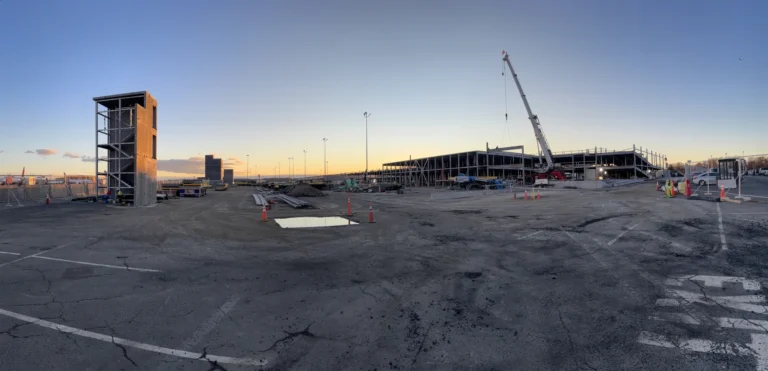
Construction Around Active Stadiums Is a Major Challenge
Stadiums have fixed schedules. Games, concerts, playoffs, training events, graduations, and community events cannot always move around construction.
That makes stadium parking construction more complex.
Construction teams need to plan for:
- Event calendars
- Temporary loss of existing parking
- Pedestrian detours
- Emergency vehicle access
- Crane locations
- Material staging
- Utility conflicts
- Road closures
- Noise, dust, and public safety
For active stadium sites, prefabricated parking structure construction can offer major advantages. More work happens off site. On-site assembly can move faster. Weather delays may be reduced.
This can help limit disruption to stadium operations.
Why Durability Matters for Stadium Parking Garages
Stadium parking structures experience heavy use in short bursts. The garage may sit lightly used on some days, then handle thousands of vehicles during an event.
That type of use creates wear.
In cold climates, stadium parking garages also deal with snow, salt, ice, drainage, freeze-thaw cycles, and spring cleaning. Facility teams need a structure that is durable and practical to maintain.
Important durability considerations include:
- Corrosion protection
- Drainage slopes
- Joint detailing
- Traffic surface protection
- Snow clearing routes
- Stair and elevator lobby finishes
- Lighting maintenance
- Cleaning access
A low-maintenance parking structure can reduce long-term operating costs. It can also reduce the need to close areas for repairs during the stadium season. This is why a prefabricated UHPC panel and steel beam approach is considered one of the best construction methods for stadium parking structures.
EV Charging, Solar, and Sustainable Stadium Parking
Sustainable stadium parking is becoming more important. Stadium owners, municipalities, and universities are often under pressure to reduce emissions, improve land use, and support cleaner transportation.
A future-ready stadium parking structure may include:
- EV charging for fans, staff, and fleet vehicles
- Solar panels on the roof or facade
- Bike parking and micromobility connections
- Shuttle and transit connections
- Efficient LED lighting
- Stormwater management strategies
- Durable materials with lower maintenance needs
EV charging for stadium parking should be planned early. Electrical capacity, conduit routes, transformer space, and future expansion should be considered before construction starts.
The same is true for solar. Parking structures often have large roof areas that can support energy generation if the structure is designed for it.
How the Kiwi CarPark System Applies to Stadium Parking Structures
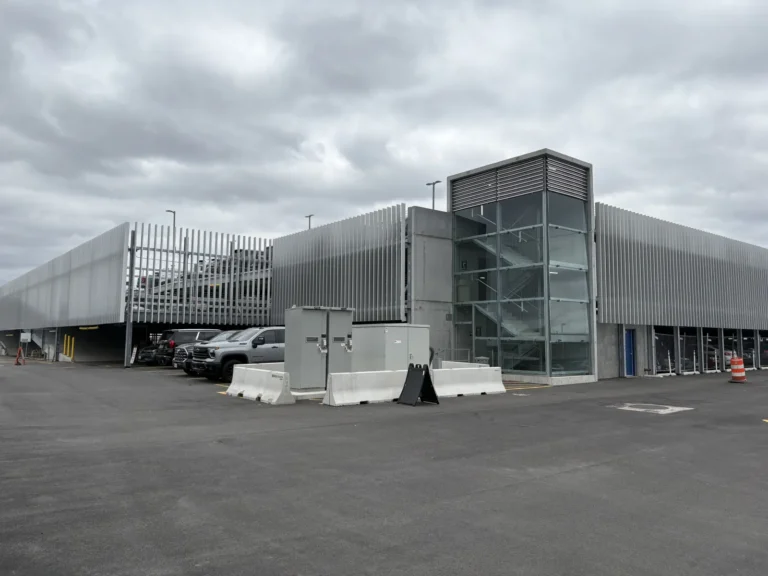
Kiwi Newton’s Kiwi CarPark System is a modular parking structure system for above-grade parking structures. It combines hot-dipped galvanized steel with ultra-high-performance precast concrete.
For stadium parking structure design and construction, several features are especially relevant.
1. Prefabricated Construction
The Kiwi CarPark System uses prefabricated components manufactured off site. This can reduce on-site construction time and help with schedule predictability.
For stadium sites, that matters. Less time on site can mean less disruption around event calendars, active roads, and existing parking areas.
2. Open Sightlines
The system is designed to create open parking areas with clear visibility. This supports CPTED principles, camera coverage, natural light, and easier wayfinding.
For stadium crowds, visibility is a major safety and comfort benefit.
3. Durable Materials
The Kiwi CarPark System uses hot-dipped galvanized steel and UHPC precast floor slabs. This approach is designed for long-term durability and reduced maintenance.
For stadium owners, durability is not a small detail. Maintenance closures can affect revenue, operations, and the fan experience.
4. Reduced Maintenance
Traditional parking structures often require traffic toppings across large surfaces. Kiwi’s system is designed to reduce that maintenance burden by limiting epoxy topping to the joints between slabs.
That can help reduce lifecycle maintenance costs over the life of the structure.
5. Efficient Layouts
A stadium parking garage needs to move people and vehicles quickly. Efficient structural layouts can support better circulation, more comfortable driving, and improved parking capacity within the available footprint.
To learn more about Kiwi’s broader approach to parking structure construction, visit the main parking structures page.
Related Parking Structure Topics to Consider
Stadium parking is a specialized topic, but it connects to many broader parking structure issues.
For deeper planning, these Kiwi resources may also be useful:
- Things to know before building a parking structure
- How much does it cost to build a parking structure?
- How long does it take to build a parking structure?
- Open-air parking structures
- CSA S413 for parking structures
- CPTED for parking structures
- UHPC for parking structure construction
- Galvanized steel for parking structure construction
Stadium Parking Structure Planning Checklist
Before starting parking structure design for stadiums, owners and project teams should answer these questions.
- How many vehicles need to arrive during the busiest pre-event window?
- How many vehicles need to leave during the first 30 to 60 minutes after the event?
- Where will queues form if entry processing slows down?
- How will VIP, staff, media, accessible, bus, shuttle, and general parking be separated?
- Where do pedestrians naturally want to walk?
- Can pedestrians reach the stadium without crossing major garage exit flows?
- How will accessible users move from parking to the stadium entrance?
- Does the stadium need surface parking for tailgating?
- Can the parking structure support non-event use?
- How will the structure be maintained during the stadium season?
- Can the garage be built without disrupting events?
- Should the structure include EV charging, solar, or future expansion capacity?
Common Mistakes in Stadium Parking Design
Stadium parking garage projects can run into problems when they are treated like standard parking projects.
Common mistakes include:
- Designing only for stall count
- Underestimating post-event exit demand
- Creating too few entry or exit points
- Putting pedestrian exits in the wrong place
- Forcing pedestrians across active vehicle exits
- Ignoring tailgating and fan culture
- Treating accessible parking as a code checkbox
- Forgetting about buses, media, RVs, and service vehicles
- Choosing materials without considering lifecycle maintenance
- Failing to plan construction around the stadium schedule
The best stadium parking structure projects solve these issues early. Once the garage is built, poor circulation and poor pedestrian routes are hard to fix.
FAQ: Stadium Parking Structure Design and Construction
What makes a stadium parking structure different from a regular parking garage?
A stadium parking structure must handle large surges of traffic before and after events. It also has to manage large pedestrian crowds, accessible routes, security, tailgating, buses, shuttles, and event-day operations.
Is stall count the most important factor?
No. Stall count is important, but throughput is often more important. The garage must be able to process vehicles quickly and empty safely after the event.
Should stadiums use surface parking or structured parking?
It depends on the site. Surface parking can support tailgating and oversized vehicles. Structured parking can fit more vehicles on less land and free up space for better stadium district uses.
Why is pedestrian flow so important?
After a game, thousands of people may walk to the garage at the same time vehicles are leaving. Poor pedestrian planning can create safety risks and slow vehicle exits.
What is the best construction method for a stadium parking garage?
The best method depends on the site, budget, schedule, and operating constraints. Prefabricated and modular parking structure systems can be useful because they reduce on-site work and can help limit disruption around active stadiums.
Can stadium parking structures include EV charging?
Yes. EV charging can be included, but it should be planned early. Electrical capacity, conduit, transformer space, and future expansion should be considered during design.
How can parking structures improve stadium safety?
Safety can be improved through open sightlines, strong lighting, clear wayfinding, visible stairs and elevators, good camera coverage, and separated pedestrian routes.
Building Better Stadium Parking Structures
Stadium parking structure design and construction is about more than adding parking spaces. It is about moving people, protecting pedestrians, reducing traffic pressure, supporting the fan experience, and creating infrastructure that lasts.
The best stadium parking structures are planned as part of the full event-day system. They connect traffic flow, pedestrian movement, accessibility, security, operations, land use, and long-term maintenance.
When done well, a stadium parking structure can improve more than parking. It can help the whole stadium district work better.
Key Takeaways
- Stadium parking is surge-based, so throughput matters as much as stall count.
- Ingress and egress should be planned as separate operating modes.
- Pedestrian flow is one of the most important parts of stadium parking design.
- Tailgating may require surface parking, special zones, or a blended parking strategy.
- Accessible stadium parking must connect directly to accessible stadium entrances.
- Open sightlines, lighting, and CPTED principles improve safety and comfort.
- Prefabricated parking structures can reduce disruption around active stadium sites.
- Durability, drainage, corrosion protection, and maintenance should be considered early.
- EV charging, solar, and future flexibility should be planned before construction.
- The Kiwi CarPark System is well suited to many stadium parking needs because it combines prefabrication, open-span design, durable materials, and reduced maintenance.