
TLDR: UHPC Panel-and-Beam parking structures use prefabricated UHPC deck panels on galvanized steel beams. The method combines off-site fabrication, open-span layouts, durable driving surfaces, and reduced reliance on full-surface deck toppings. It is best understood as one of the main parking structure construction methods, alongside Cast-in-Place and Double Tee.
UHPC Panel-and-Beam is a prefabricated parking structure construction method that uses UHPC deck panels supported by steel beams. For owners comparing Cast-in-Place, UHPC Panel-and-Beam, and Double Tee construction, it provides a clear way to think about schedule, durability, maintenance, safety, and long-term value.
This article explains how the method works, where it fits, and why it should be considered early when planning an above-grade parking structure.
Why Parking Structure Construction Methods Matter
A parking structure is not just a place to store cars. It is a long-term infrastructure asset exposed to water, chlorides, freeze-thaw cycles, vehicle loads, snow removal equipment, and daily traffic.
The construction method chosen at the start affects almost everything that follows:
- capital cost;
- construction schedule;
- maintenance cost;
- repair downtime;
- user safety;
- lighting and sightlines;
- future expansion;
- long-term asset value.
For many owners, the early conversation usually centres on Cast-in-Place, UHPC Panel-and-Beam or Double Tee construction.
If you are planning a project, our parking structure construction page provides a broader overview of design-build parking structure delivery.
What Is UHPC Panel-and-Beam?
UHPC Panel-and-Beam is a parking structure construction method that uses UHPC deck panels supported on galvanized steel beams. The UHPC panels form the parking deck surface, while the steel beams provide the primary spanning structure.
In a typical configuration, the structure includes:
- UHPC deck panels;
- galvanized steel beams;
- galvanized steel columns;
- stairs and walls where required;
- connections between panels and beams;
- grouted joints;
- joint sealing or localized topping only at panel joints.
This creates a steel and UHPC parking structure that is assembled from repeatable components. It is not the same as a conventional precast Double Tee system. It is also not the same as a fully Cast-in-Place concrete garage.
The method sits between both ideas and is a common construction method for parking structures in Europe. It uses the speed of prefabrication, the span efficiency of steel, and the durability of UHPC deck panels.
How UHPC Panel-and-Beam Compares to Cast-in-Place and Double Tee
Owners should evaluate parking structure construction methods based on both first cost and long-term performance. A low initial price can become expensive if it creates years of maintenance, disruption, or repair exposure.
| Method | How It Works | Best Fit | Key Considerations |
|---|---|---|---|
| Cast-in-Place | Concrete is formed, reinforced, poured, and cured on site. | Complex geometry, below-grade work, and highly customized structures. | Longer site duration, weather exposure, forming labour, and deck protection requirements. |
| UHPC Panel-and-Beam | Prefabricated UHPC deck panels are installed on steel beams. | Above-grade parking structures, open-span layouts, faster delivery, and low-maintenance ownership. | Requires early coordination, experienced detailing, and ultra high performance concrete. |
| Double Tee | Large precast Double Tee members form the deck and span between supports. | Conventional precast parking structures with familiar supply chains. | Joint maintenance, structural depth, topping strategy, and layout constraints should be reviewed early. |
This is not about declaring one method best for every project. It is about choosing the right method for the owner’s priorities.
For example, Cast-in-Place may suit complex underground conditions. Double Tee may suit owners who want a familiar precast approach. UHPC Panel-and-Beam may suit owners who want an above-grade, open-span parking structure with reduced long-term maintenance demands.
Why UHPC Deck Panels Matter
UHPC stands for ultra-high-performance concrete. It is a dense, high-strength concrete material designed for durability, low permeability, and long-term performance.
The American Concrete Institute describes UHPC as a class of concrete with improved strength, ductility, durability, and fibre-reinforced performance compared with conventional concrete.
In parking structures, this matters because the deck is the battlefield. It receives vehicle traffic, water, salt, snow, ice, and maintenance equipment.
When UHPC deck panels are used as the primary driving surface, the system can reduce dependence on full-surface traffic toppings. That changes the maintenance profile of the structure.
For a deeper discussion of the material itself, see Kiwi Newton’s article on UHPC for parking structures.

Why Steel Beams Matter
In many conventional concrete parking structures, important steel reinforcement is hidden inside the concrete. That can make deterioration harder to see until damage has already progressed.
UHPC Panel-and-Beam construction uses steel beams as visible, inspectable primary structural members. This gives owners and maintenance teams a clearer view of the main spanning elements over time.
When those beams are hot-dip galvanized, they receive corrosion protection before they arrive on site. The American Galvanizers Association explains time to first maintenance as the point when 5 percent rusting of the base steel surface occurs.
For parking structures, that matters because exposed steel must be protected from moisture and chlorides. Galvanizing is a common way to extend the service life of the steel frame.
We written other articles on steel beams in parking structures and galvanized steel for parking structure construction.

How the Structure Works
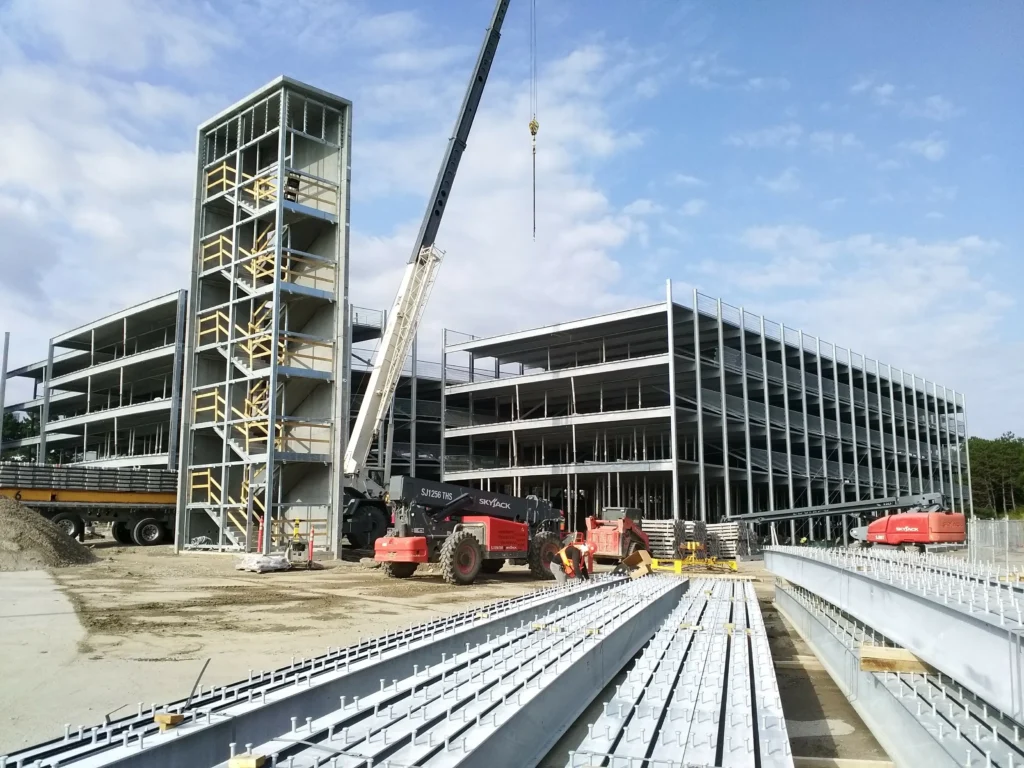
The basic idea is simple. Steel beams span between columns. UHPC deck panels sit on those beams. The panels and beams are connected so they work together structurally.
In a typical composite steel and UHPC parking structure, steel studs are welded to the top of the beam. The prefabricated UHPC panels are placed over the beams. Embedded reinforcement or connection details in the panels align with the studs.
After the panels are placed, structural grout fills the connection zones. Once the grout cures, the deck panels and steel beams act together as a composite section.
This allows the structure to achieve open spans while maintaining a relatively efficient floor depth. It also reduces the need for interior columns in drive aisles, depending on the layout and engineering requirements.
The key idea is not just prefabrication. The key idea is separating the durable driving surface from the primary spanning beam, then connecting them into one coordinated structural system.
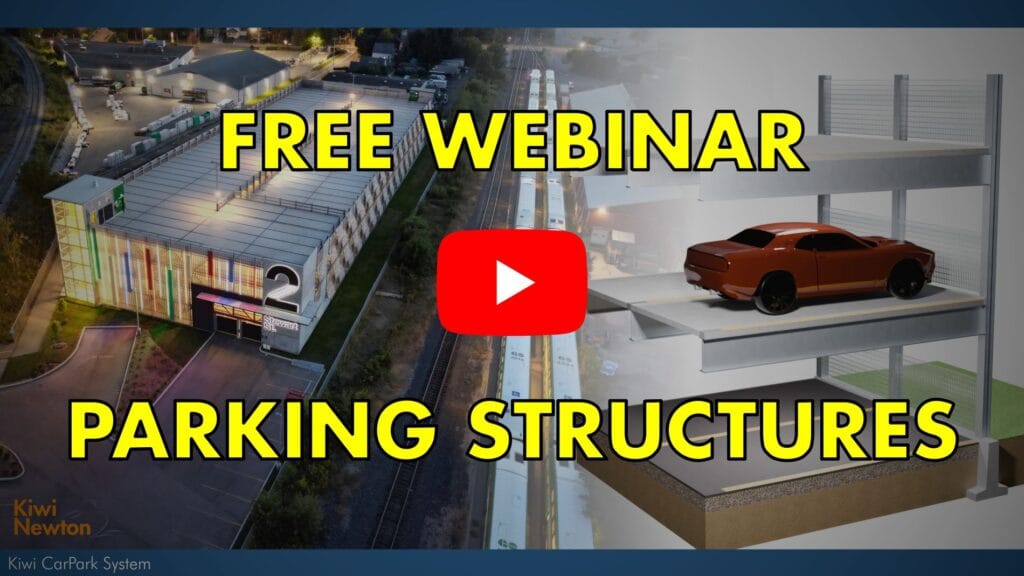
We have a recorded webinar which outlines our version of the UHPC-Panel-and-Beam approach:
Typical Layout Logic for UHPC Panel-and-Beam Parking Structures
Parking structures are repetitive by nature. That makes them a good fit for prefabricated parking structures.
A UHPC Panel-and-Beam layout is usually planned around efficient parking modules. The design team reviews stall width, stall length, drive aisle width, ramping, turning movements, clear height, structural depth, and façade requirements together.
The goal is to create a layout that works for drivers and can be manufactured efficiently.
Important layout considerations include:
- parking stall dimensions;
- drive aisle width;
- ramp location and slope;
- clear height;
- floor-to-floor height;
- column locations;
- lighting;
- stair and elevator placement;
- snow storage and drainage;
- EV charging and future conduit routes;
- solar roof or façade options.
This is why early design coordination matters. A prefabricated parking garage performs best when the structure, layout, drainage, lighting, façade, and maintenance strategy are considered together.
Construction Sequence
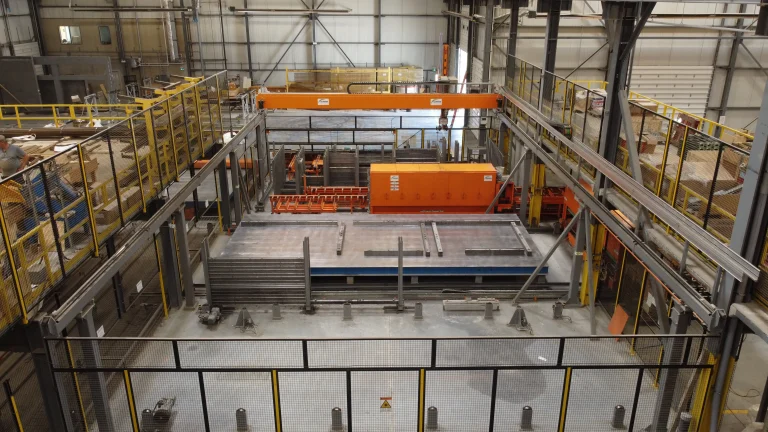
One of the main advantages of UHPC Panel-and-Beam is that much of the work shifts from the job site to the factory. This can reduce site congestion and improve quality control.
A typical sequence may include (note many of these overlap):
- fabricate steel beams and columns;
- produce UHPC deck panels in a controlled environment;
- complete foundations and below-grade work;
- deliver structural components to site;
- erect steel columns and beams;
- temporarily support or jack beams as required for camber control;
- place UHPC deck panels;
- grout the connection zones;
- seal or treat the panel joints;
- repeat the process for additional levels;
- complete stairs, elevators, façade, lighting, drainage, and equipment.
This sequence supports faster on-site assembly than many fully site-built approaches. It also allows design, manufacturing, and site preparation to overlap when the project is managed correctly.
For more context on schedule, see Kiwi Newton’s article on how long it takes to build a parking structure.

Maintenance Strategy: Why the Deck System Changes the Cost Profile
Parking garage maintenance costs are often driven by water, salt, cracks, joints, coatings, membranes, and deck deterioration. The deck system selected at the start can shape the maintenance budget for decades.
In many structures, the driving surface relies heavily on a full-surface traffic topping, membrane, or protective coating strategy. These systems can work, but they must be inspected, maintained, and eventually renewed.
UHPC Panel-and-Beam changes the discussion. Because the UHPC panels serve as the durable driving surface, maintenance can focus more heavily on the panel joints and localized details rather than the entire deck surface.
This does not mean “no maintenance.” Every parking structure needs inspections, cleaning, drainage maintenance, joint reviews, and repairs when required.
It does mean the owner should compare the lifecycle maintenance profile of each method before selecting a structural system.
For a related safety and durability discussion, see Kiwi Newton’s article on why parking structures collapse.
User Experience and Safety
Parking structures are used by people, not just cars. Drivers, pedestrians, students, patients, staff, travellers, and visitors all experience the structure differently.
Open-span parking structures can improve visibility by reducing interior columns and hidden corners. Better sightlines can make a garage feel safer and easier to navigate.
UHPC Panel-and-Beam can also support:
- more open drive aisles;
- clearer pedestrian routes;
- better camera visibility;
- natural light and ventilation;
- high-visibility stair towers;
- logical wayfinding;
- reduced conflict between drivers and pedestrians.
These ideas connect closely with Crime Prevention Through Environmental Design, often called CPTED. In simple terms, the structure should avoid creating dark, confusing, or hidden spaces.
For many projects, the open-air design also matters. You can learn more in Kiwi Newton’s guide to open-air parking structures.
Where UHPC Panel-and-Beam Is Most Useful
UHPC Panel-and-Beam is most useful for above-grade parking structures where speed, durability, maintenance, and user experience matter.
Common project types include:
- municipal parking structures
- university and college parking garages
- hospital parking structures
- airport parking garages
- stadiums and arenas
- transit park-and-ride structures
- residential development parking
- commercial and industrial campus parking
- temporary or demountable parking structures where future flexibility is important.
For owners concerned about project economics, above-grade parking can also reduce the need for expensive underground parking. This can be especially important for residential and mixed-use developments.
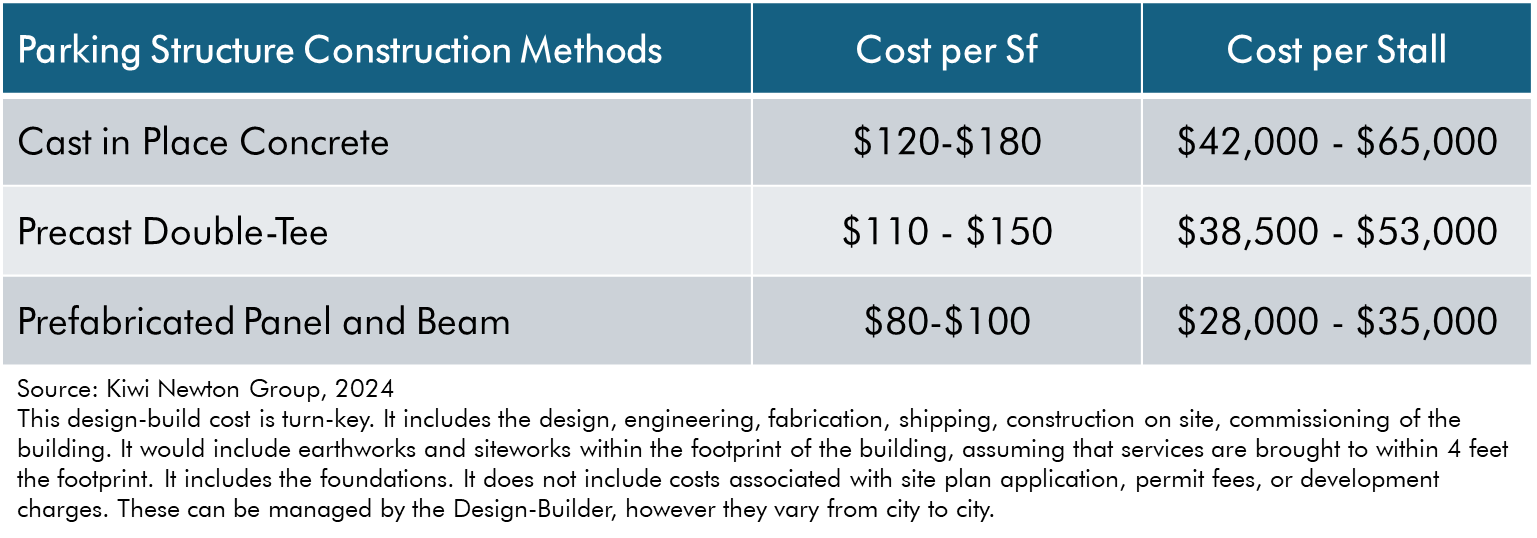
Kiwi Newton discusses related budget considerations in its article on how much it costs to build a parking structure.
Cost, Schedule, and Lifecycle Considerations
First cost matters. Owners have budgets, funding approvals, and business cases to satisfy.
But parking structures should not be evaluated on first cost alone. A structure that is cheaper to build but more expensive to maintain may not be the best long-term value.
A useful comparison should include:
- capital cost per stall;
- construction duration;
- site disruption;
- foundation implications;
- maintenance schedule;
- deck coating or topping replacement cycles;
- joint maintenance;
- snow removal requirements;
- energy use for lighting and ventilation;
- future expansion options;
- repair downtime;
- expected service life.
This is where UHPC Panel-and-Beam can be attractive. It combines prefabrication with a durable deck surface and an inspectable steel frame.
Cost consultants should also classify the scope clearly. The method includes structural steel, UHPC panel fabrication, transportation, erection, grouting, joint treatment, stairs, walls, façade elements, lighting, drainage, and project-specific systems.
Double Tee Conversion: When an Existing Design Becomes Too Expensive
Many parking structures begin as Double Tee designs because that method is familiar. Sometimes the project later becomes too expensive, too deep, too maintenance-heavy, incompatible with poor soil conditions or difficult to coordinate with the owner’s goals.
That is where Double Tee conversion becomes useful.
A Double Tee conversion is not usually about modifying an existing built garage. It is usually about re-designing an unbuilt Double Tee concept into a UHPC Panel-and-Beam structure.
The design team can review:
- the existing stall count;
- the site envelope;
- floor-to-floor height;
- ramp locations;
- column grid;
- drive aisles;
- stair and elevator cores;
- façade requirements;
- estimated cost;
- long-term maintenance assumptions.
The goal is to answer a simple question:
Can the owner keep the parking function but change the structural method to improve cost, schedule, maintenance, or layout performance?
This can be useful for municipalities, universities, hospitals, airports, developers, and public agencies that already have drawings but need a better path forward.
How Owners Can Specify UHPC Panel-and-Beam
An owner can ask for a parking structure that meets defined outcomes and allow qualified teams to propose compliant methods.
Example procurement language:
The parking structure may be delivered using Cast-in-Place, UHPC Panel-and-Beam, or Double Tee construction. The proposed structure shall be designed to provide a durable, low-maintenance, above-grade parking facility with efficient structural spans, clear sightlines, corrosion-resistant primary structural elements, reduced long-term deck maintenance, and a documented lifecycle maintenance plan.
The design should minimize reliance on full-surface traffic toppings or membranes where practical, reduce hidden deterioration risks, support efficient inspection and maintenance, and provide a clear strategy for joints, drainage, chloride exposure, snow removal, freeze-thaw durability, and future repair access.
This language helps owners compare methods fairly.
How Kiwi Newton Delivers UHPC Panel-and-Beam Parking Structures
Kiwi Newton delivers UHPC Panel-and-Beam parking structures through its Kiwi CarPark building system. The approach combines design-build delivery, steel fabrication, precast manufacturing, UHPC deck panels, galvanized steel, and on-site assembly.
The purpose is not simply to sell parts. The purpose is to integrate planning, design, manufacturing, logistics, construction, and maintenance thinking into one coordinated delivery model.
That matters because UHPC Panel-and-Beam works best when decisions are coordinated early. The structure, layout, drainage, façade, lighting, erection sequence, maintenance plan, and procurement model should all support the same goal.
For owners, the value is clarity. Instead of treating the parking structure as a one-off problem, the project can be planned around a defined construction method with repeatable components and known decision points.
Key Takeaways
- UHPC Panel-and-Beam is a prefabricated parking structure method using UHPC deck panels supported on steel beams.
- The method is especially relevant for above-grade parking structures.
- UHPC deck panels can reduce reliance on full-surface traffic topping strategies.
- Galvanized steel beams provide an inspectable primary structure with corrosion protection.
- Open-span layouts can improve visibility, safety, lighting, and user experience.
- Double Tee conversion can help owners revisit projects that have become too expensive or difficult to proceed with.
- Public owners can specify UHPC Panel-and-Beam through performance-based procurement language.
Parking structures are long-term assets. The construction method should be chosen with the same long-term thinking. UHPC Panel-and-Beam gives owners, designers, and procurement teams another practical method to evaluate before committing to a final design.