
Article Quick Summary
Parking structures for car dealerships help auto dealers store more vehicles on the same property, reduce off-site inventory problems, protect saleable inventory, improve security, and create a cleaner site plan for customers, employees, sales, service, and delivery.
A car dealership is not a typical parking user.
A dealership lot is a sales floor, an inventory yard, a customer parking area, an employee parking area, a service intake zone, a test-drive staging area, a delivery area, a detailing area, and a pre-delivery inspection (PDI) area all at once.
That creates a planning problem most parking projects don’t have.
As inventory grows, service volumes increase, and customer expectations rise, many dealerships find that their main lot no longer has enough room to support every function properly. The dealership may still have strong frontage, steady traffic, and a valuable location, but the property itself becomes constrained.
One common workaround is to rent an off-site inventory lot. At first, this can look like a simple fix. But off-site storage can create hidden costs and operational risks, including vehicle transfers, staff time, security concerns, weather exposure, insurance questions, customer friction, and reduced sales flexibility.
A purpose-built dealership parking structure solves the problem differently. Instead of sending vehicles away from the main property, the dealership can increase capacity vertically, keeping more inventory, employee parking, and customer access on site.
A dealership doesn’t just need more parking spaces. It needs a better way to store, protect, move, show, and sell vehicles.

Specific Parking Expansion Challenges for Car Dealerships
Car dealerships face parking challenges that are different from most commercial, municipal, or institutional parking sites.
A dealership does not just need spaces for people to park. It needs space to store, display, move, inspect, service, charge, protect, and sell vehicles.
Those competing demands should shape the parking plan from the start.
Off-Site Inventory Lots Create Sales Friction
Many dealerships rent empty lots, industrial yards, or overflow properties 10 to 30 minutes away from the main store. These lots may hold new inventory, used inventory, fleet vehicles, slower-moving units, demos, trade-ins, or vehicles waiting for service, detailing, PDI, or delivery.
On paper, this creates more space.
In practice, it creates a second operation.
If a customer wants to see a vehicle that is stored off site, the dealership has to send someone to retrieve it. The customer waits. The salesperson loses momentum. The vehicle has to be driven through traffic. The buying experience gets interrupted before the customer has even seen the car.
Off-site storage also changes how customers shop. When vehicles are not on the main lot, the customer often has to know exactly which vehicle they want before it is brought over.
That reduces browsing, comparison, and discovery.
A customer who came to see one model may never see the upgraded trim, alternate colour, certified pre-owned unit, special edition, or higher-margin vehicle that could have been a better fit.
A dealership sells what it can show. When inventory is off site, sales flexibility drops.
Vehicle Transfers Add Risk
Every transfer between a remote lot and the main dealership creates another chance for something to go wrong.
Vehicles can pick up dings, dents, curb rash, stone chips, windshield damage, interior wear, added mileage, or accident exposure while being moved between sites.
Even when insurance is available, the dealership still has to manage the disruption. A damaged vehicle may need to be repaired, reconditioned, discounted, disclosed, or removed from saleable inventory until the issue is resolved.
There is also a staffing issue. In many cases, vehicles are moved by junior staff, lot attendants, or lower-wage employees who are asked to drive saleable inventory from a packed remote lot through city traffic back to the dealership.
That is a lot of risk for a space problem.
A parking structure can reduce unnecessary vehicle movement by keeping more inventory on the main site.
Remote Lots Are Harder to Secure
The main dealership site usually has staff presence, better lighting, cameras, fencing, controlled access, and more activity. Remote lots often do not.
Overflow lots can create concerns around:
- Vehicle theft
- Break-ins
- Vandalism
- Catalytic converter theft
- Wheel and tire theft
- Key control
- After-hours monitoring
- Unauthorized access
- Insurance requirements
- Liability while vehicles are stored away from the main dealership
A remote lot may be cheaper than buying more land, but it is often harder to control.
A dealership parking structure can consolidate inventory into a more secure environment with fewer access points, better lighting, clearer sightlines, cameras, gates, and controlled entry.
Security should also be considered through the lens of CPTED for parking structures, which stands for Crime Prevention Through Environmental Design. The basic idea is simple: design the structure so people, cameras, and staff can see what is happening.
Weather Exposure Affects Saleable Inventory
Dealership inventory is valuable. Leaving that inventory outside exposes it to rain, snow, ice, hail, sun, bird droppings, tree sap, wind-blown debris, dust, and freeze-thaw conditions.
For a dealership, this affects sale readiness.
Vehicles may need more frequent washing, detailing, snow clearing, inspection, or reconditioning before they can be shown. A customer viewing a dirty, snow-covered, hail-damaged, or weathered vehicle may not experience the vehicle the way the dealership intended.
A parking structure can help protect inventory by moving vehicles onto covered levels. With an optional roof or canopy on the top level, the dealership can extend that protection to the most exposed part of the structure.
This can be useful for:
- High-value inventory
- Luxury vehicles
- Electric vehicles (EVs)
- Demos
- Freshly detailed vehicles
- Customer delivery vehicles
- Sold units waiting for pickup
- Used vehicles that have already been reconditioned
- Vehicles that are more vulnerable to hail or sun exposure
Weather protection helps preserve inventory quality and presentation.
Gravel, Field, and Industrial Overflow Lots Can Create Cleanliness and Pest Issues
Some off-site inventory lots are not purpose-built vehicle storage areas. They may be gravel lots, open fields, industrial yards, or low-traffic properties used because they are available and affordable.
Those sites can introduce new issues.
Vehicles may sit near weeds, grass, mud, dust, standing water, or debris. In some cases, dealerships may deal with rodents, insects, or other pests getting into vehicles that sit for longer periods.
This can create additional cleaning, inspection, detailing, and customer satisfaction problems.
A structured on-site storage solution gives the dealership a cleaner, more controlled place to hold inventory.
Employee Parking Consumes Valuable Sales Space
Employee parking is necessary, but it can quietly consume some of the most valuable land on the dealership property.
When staff vehicles occupy spaces near the showroom, service entrance, front display line, or customer parking area, those spaces are no longer available for customers, inventory, service flow, or display vehicles.
Over time, employee parking can push inventory into less organized areas, reduce the number of customer spaces, and make the dealership feel crowded.
A parking structure can help separate employee parking from customer-facing operations. One level or zone can be dedicated to employees, while the most visible and convenient surface areas remain available for customers, service intake, and vehicle display.
Customer Parking Can Become Confusing
A dealership that looks full, crowded, or disorganized can create friction before the customer enters the showroom.
Customers may not know where to park. Service customers may block sales areas. Sales customers may accidentally park in inventory rows. Test-drive vehicles may be buried. Delivery vehicles may compete with customer traffic. Employees may park in the most convenient spaces because there is nowhere else to go.
The customer experience starts in the parking lot.
A parking structure can help organize the site by separating functions. Customer parking can remain close to the showroom and service entrance. Employee parking can move to a dedicated area. Inventory can be stored in a structured, controlled environment.
Service intake, test drives, PDI, delivery, and customer circulation all become easier to understand when every function has a planned place.
Service, PDI, Delivery, and Inventory Compete for the Same Space
Dealership parking is not static. Vehicles are constantly moving.
A typical dealership must support:
- New vehicle inventory
- Used vehicle inventory
- Customer parking
- Employee parking
- Service customer parking
- Service intake and drop-off
- Test-drive staging
- Vehicle delivery
- PDI
- Detailing
- Trade-in holding areas
- EV charging
- Demo vehicles
- Loaner vehicles
- Transport truck deliveries
- Snow storage and winter operations
The problem is not just “we need more spaces.” Too many dealership functions are competing for the same surface area.
A dealership parking structure should be planned around operations, not just stall count. The design should consider how vehicles move between the structure, showroom, service department, wash bay, PDI area, delivery area, and customer parking.
Land Is Expensive, Limited, or Already Fully Used
Many dealerships are located on high-value retail corridors, highway sites, or busy commercial roads. These are excellent locations for sales visibility, but they often leave little room for horizontal expansion.
The dealership may have strong frontage, a good brand presence, and the right market location, but the property itself may be built out.
Structured parking allows a dealership to grow vertically on land it already controls.
Instead of buying more land, leasing remote storage, or limiting inventory, the dealership can increase vehicle capacity within the existing site.

Why Car Dealerships Should Consider a Parking Structure
A parking structure can help a dealership solve several problems at once.
It can increase inventory storage, reduce vehicle transfers, improve security, protect saleable inventory, free up customer parking, move employees away from the front lot, and create a more organized site.
For dealerships, this is not just parking. It is operational infrastructure.
More Inventory on the Same Property
A parking structure allows dealerships to increase vehicle capacity vertically instead of expanding horizontally.
This can help dealerships keep more inventory on the main site, where sales staff, service staff, detailers, and customers can access it more quickly.
When inventory is on site, the dealership can respond faster. A salesperson can show a similar model, alternate colour, upgraded trim, used unit, or demo vehicle without sending someone to a remote lot.
That creates a better sales process.
Less Dependence on Remote Storage
Off-site storage may solve the space problem temporarily, but it creates new problems every day.
A dealership parking structure can reduce reliance on remote lots by bringing more inventory back to the main property. That means fewer vehicle transfers, less staff time spent shuttling cars, fewer delays for customers, and better control over the inventory.
For dealerships that are already renting overflow lots, the cost of remote storage should be evaluated beyond rent alone. Staff time, vehicle movement, damage risk, customer delay, security, insurance, and missed sales opportunities should all be part of the discussion.
Better Security and Access Control
Structured parking can make dealership inventory easier to secure.
Compared with a wide-open surface lot or remote storage yard, a parking structure can consolidate access through controlled entry and exit points. Gates, cameras, lighting, secure stair towers, license plate recognition, and staff-only zones can all be considered.
Clear sightlines are also useful. A parking structure with open spans, bright lighting, and fewer hidden areas can support better surveillance and a stronger sense of security.
The Whole Building Design Guide also notes that parking facilities need to deal with safe and efficient vehicle movement, pedestrian access, security, and operations together. That same logic applies to a dealership, where inventory and customers move through the same constrained site.
Improved Weather Protection
A parking structure can protect vehicles on covered levels, reducing exposure to rain, snow, ice, sun, bird droppings, and debris.
With an optional roof or canopy system on the top level, the dealership can create more complete weather protection across the structure.
This improves vehicle presentation and may reduce the amount of cleaning, snow clearing, and detailing required before customer showings.
A Better Customer Experience
Customers should not have to navigate a crowded lot, guess where to park, or wait while vehicles are retrieved from an off-site storage location.
A dealership parking structure can help create a clearer site plan. Customer parking can remain convenient and visible. Inventory can be organized by level, model, brand, turnover priority, or access requirements.
Employees can park away from the front door. Service vehicles can have designated areas. Customers can understand where to go without asking three people first.
Stronger Inventory Turnover
Inventory turnover depends on visibility, accessibility, and speed.
The National Automobile Dealers Association (NADA) includes inventory turn, aged inventory, and the relationship between new and used vehicle operations in its dealership variable operations training. Those ideas connect directly to the physical layout of the lot.
If vehicles are difficult to access, buried in the lot, or stored 20 minutes away, the sales process slows down. If they are on site, organized, protected, and easy to retrieve, the dealership can sell more efficiently.
A parking structure can support better inventory turnover by making more vehicles available on the main property without sacrificing customer parking or service flow.
Unique Design Features for Dealership Parking Structures
A dealership parking structure should not be designed exactly like a municipal garage, hospital garage, airport garage, or shopping centre garage.
The design should begin with dealership operations.
Who uses the structure? What vehicles are stored there? Which areas are public? Which areas are staff-only? Which vehicles need the fastest access? Which areas require weather protection? How does the structure connect to the showroom, service department, PDI, detailing, delivery, and customer parking?
Those questions shape the design.
Open Spans, Natural Light, and Clear Sightlines
Open spans are especially valuable for car dealerships.
A dealership structure may be used for inventory storage, employee parking, customer browsing, premium vehicle display, or all of the above. It should feel open, visible, and easy to navigate.
Clear sightlines help staff monitor inventory, move vehicles safely, and find the vehicles they need. They also improve camera coverage and reduce hidden areas.
Natural light and open-air parking structures can also make the structure feel less enclosed. This is useful if customers are allowed to browse vehicles inside part of the structure.
A dark, heavy, enclosed garage can feel like back-of-house storage. A light, open, well-lit structure can feel like an extension of the dealership environment.

Lighting for Security and Vehicle Presentation
Lighting is not just a safety requirement. For dealerships, lighting affects how vehicles look.
A dealership parking structure should consider bright, even LED lighting that reduces shadows, supports camera visibility, and improves the experience for staff and customers.
Good lighting can help with:
- Security
- Vehicle identification
- Customer browsing
- After-hours visibility
- Wayfinding
- Vehicle display
- Staff safety
- Camera performance
For premium inventory or display areas, lighting can also be used to highlight specific vehicles.
Secure Entry and Exit Points
A parking structure gives dealerships the opportunity to control access more effectively than a large open lot.
The main ramp or entrance can include gates, access control, cameras, lighting, and signage. Certain levels can be designated as staff-only, inventory-only, or customer-accessible.
This can help protect vehicles while still allowing the dealership to move inventory efficiently.
Inventory Storage vs. Employee Parking vs. Customer Parking
A dealership parking structure can be designed for different users.
An inventory-only area may prioritize storage density, staff access, security, and efficient retrieval. An employee parking area must consider daily staff use, stall dimensions, circulation, and municipal requirements. A customer-facing area must be easy to understand, accessible, safe, and convenient.
These distinctions affect the layout.
Public-facing customer parking and employee parking must be designed around applicable municipal bylaws, accessibility requirements, building code requirements, fire access, and user comfort.
Inventory-only storage may allow a dealership to explore more efficient layouts, subject to local review. That should be discussed early with the authority having jurisdiction.
Roof Systems and Top-Level Protection
The top level of a parking structure is usually the most exposed. For dealerships, every vehicle on that level is still saleable inventory.
An optional roof, canopy, or solar canopy can help protect the top level from rain, snow, sun, and hail. It can also create a more comfortable customer browsing experience in poor weather.
For dealerships with EV inventory, a roof or solar canopy may also support a broader energy strategy, especially where solar power and EV charging are being considered together.
EV Charging Infrastructure
EVs create new parking and infrastructure requirements for dealerships.
EV inventory may need charging before test drives. Demo vehicles and service loaners may need regular charging. Customers may expect charging options on site. Employees may also need access to chargers as EV adoption grows.
A dealership parking structure can be planned with EV charging zones from the beginning.
This may include:
- Charging for sale inventory
- Charging for demo vehicles
- Charging for service loaners
- Customer charging
- Employee charging
- Future electrical capacity
- Conduit and raceway planning
- Load management
- Solar integration
- Battery storage, where appropriate
The U.S. Department of Energy Alternative Fuels Data Center describes EV readiness as planning the infrastructure, policies, and services needed to support more EVs on the road. A dealership has an even more direct reason to plan ahead: the vehicles may be its own inventory.
EV charging should not be treated as an afterthought. The best time to plan for future charging is during the design of the parking structure.
Fire Access and Code Review
Dealership parking structures still need to work as buildings.
That means fire access, ventilation, travel distances, stair locations, guards, drainage, snow management, lighting, accessibility, and local zoning all need early review.
Where a project is designed as an open parking garage, opening ratios and natural ventilation rules can affect cost and design. For example, International Building Code criteria for open parking garages include requirements for the aggregate length of exterior openings used for natural ventilation.
Local requirements can differ. The project team should review the building code, municipal zoning, fire access requirements, and insurance expectations before locking in the structure layout.
Bonus Features That Can Turn the Structure Into a Dealership Asset
A dealership parking structure does not have to be hidden at the back of the site.
In the right location, it can become part of the dealership’s sales presence.
Feature Vehicle Display Bay
If the dealership is located on a busy road, highway, or prominent corner, the structure can include a feature vehicle display bay.
A premium vehicle could be displayed on an upper level, near a stair tower, behind glass, or in a specially lit area facing traffic.
This turns the structure into more than storage. It becomes a vertical display platform.
Showcase Tower or Glazed Stair Element
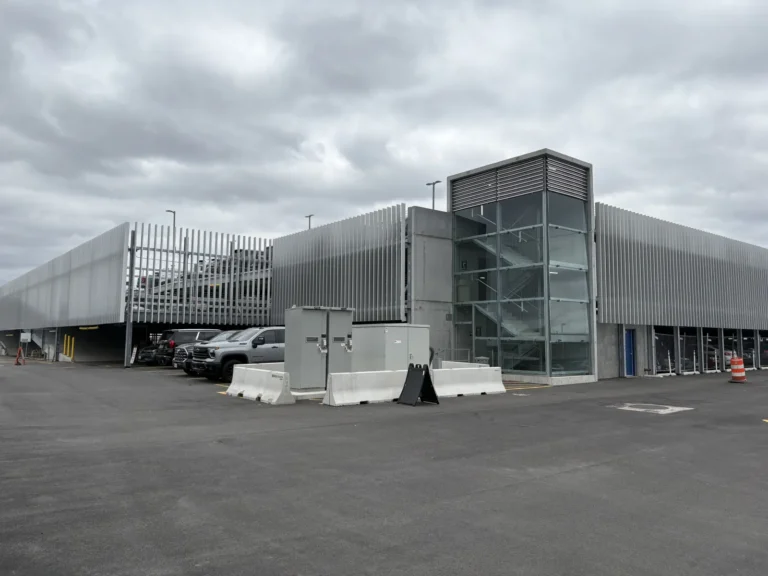
A stair or elevator tower can become a visual feature.
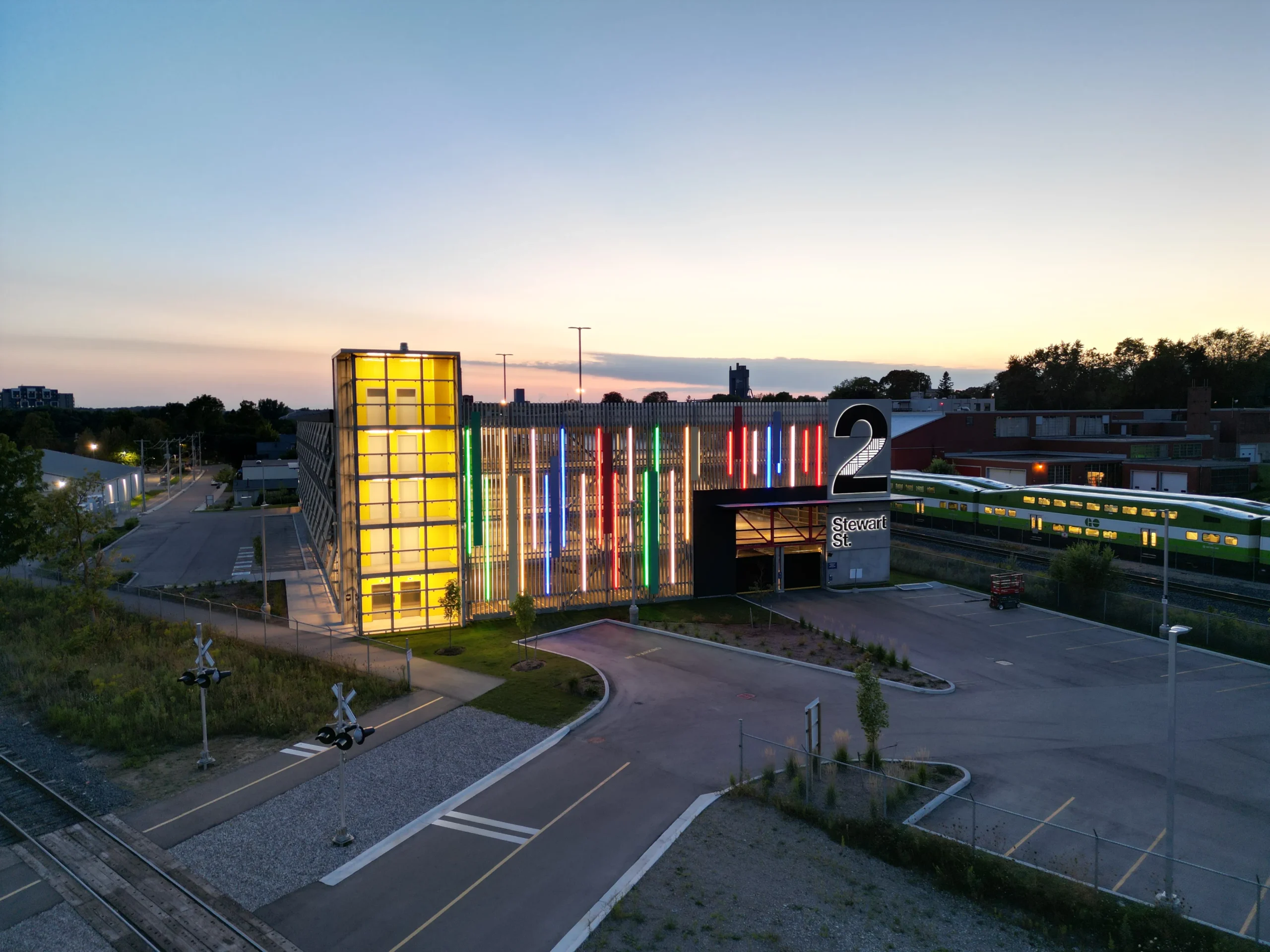
With glazing, lighting, signage, and a nearby vehicle display zone, a tower can help the structure feel connected to the dealership brand instead of looking like a generic garage.
This can be especially effective when the dealership is located along a high-traffic route.
Branded Façade
A parking structure can include façade treatments that align with the dealership’s brand and showroom design.
Options may include:
- Architectural screening
- Metal panels
- Mesh
- Vertical fins
- Branded colours
- Signage
- Lighting
- Glazed elements
- Street-facing architectural treatments
The goal is not to hide the parking structure. The goal is to make it feel like part of the dealership campus.
For dealerships with a public-facing structure, parking structure facades can help soften the appearance, support branding, and improve how the building meets the street.
Premium Inventory Zone
Dealerships may want dedicated areas for high-value vehicles, rare models, luxury inventory, demos, sold units, or delivery-ready vehicles.
A premium inventory zone can include enhanced lighting, restricted access, camera coverage, weather protection, and proximity to the showroom or delivery area.
Customer Browsing Route
Where appropriate, a dealership may allow customers to browse inventory inside part of the structure.
That requires planning. Pedestrian routes, lighting, signage, guardrails, customer access, security, and separation from staff-only areas should all be considered.
When done properly, a parking structure can create a comfortable browsing environment even on rainy, snowy, or very hot days.
Parking Structure Construction Methods for Car Dealerships
When dealerships begin exploring parking structure construction, they will usually encounter three main above-grade construction methods:
- Cast-in-place concrete
- Ultra-High Performance Concrete (UHPC) Panel-and-Beam
- Double tee precast concrete
Each method can be appropriate in the right context. The best choice depends on the site, budget, schedule, soil conditions, durability expectations, architectural goals, and how the dealership plans to use the structure.
Cast-in-Place Concrete
Cast-in-place concrete is a traditional parking structure method where concrete is formed, reinforced, poured, and cured on site.
It is familiar, widely understood, and can be used for complex or irregular layouts. For some sites, it may be the right solution.
However, cast-in-place construction can involve more on-site labour, more forming, more weather-dependent sequencing, and more disruption during construction. It can also create a heavier, more monolithic appearance.
For dealerships that need to remain operational during construction, the amount of on-site activity, staging, forming, curing time, and disruption should be considered carefully.
UHPC Panel-and-Beam
UHPC Panel-and-Beam construction uses prefabricated deck panels supported by a steel beam and column frame.
In the Kiwi CarPark System, high-performance or UHPC deck panels span between hot-dip galvanized steel beams and columns. The result is a modular, above-grade parking structure system designed for car and light vehicle parking.
For car dealerships, UHPC Panel-and-Beam can be a strong fit because it supports the qualities dealerships often need:
- Open sightlines
- Natural light
- A less monolithic appearance
- Efficient vehicle storage
- Good visibility for cameras and staff
- Flexible façade and branding options
- Potential roof, solar, and EV charging integration
- A lighter structural approach compared with some alternatives
- A clean, airy environment that can support vehicle presentation
The lighter nature of the system may also be helpful where soil conditions are a concern, although every site still requires proper geotechnical review and project-specific foundation design.
UHPC Panel-and-Beam should be understood as its own parking structure construction category, alongside cast-in-place concrete and double tee precast. It is not just a variation of a conventional garage.
It is a distinct panel-and-beam approach that can be well suited to above-grade parking structures where durability, openness, aesthetics, and construction efficiency all need to work together.
Dealerships comparing systems may also want to review Ultra High Performance Concrete (UHPC) for parking structure construction and galvanized steel for parking structure construction as part of their early material review.
Double Tee Precast Concrete
Double tee precast concrete is another common parking structure method. It uses large precast concrete tee-shaped members that form both the structure and the deck.
Double tee systems can be efficient and familiar in many parking applications. They are often used for conventional garages and larger parking structures.
However, double tee structures can create a heavier visual expression, with deeper structural members and a more traditional garage appearance.
For dealerships, this can affect how the structure looks beside a showroom, along a public road, or within a customer-facing sales environment.
When evaluating double tee construction, dealerships should consider not only cost and capacity, but also appearance, sightlines, lighting, maintenance expectations, and how the structure will feel to customers and staff.
Why UHPC Panel-and-Beam Works Well for Car Dealerships
A dealership parking structure is not simply a storage building.
It may be seen by customers, used by employees, connected to service operations, and visible from a major road.
That puts pressure on both performance and appearance.
It Supports Clear Sightlines
Open visibility supports both sales and security.
Staff need to find vehicles quickly. Cameras need clear coverage. Customers may need to browse inventory. Managers need to monitor vehicle movement. Security teams need fewer hidden areas.
A panel-and-beam structure can support open sightlines and clear circulation.
It Can Feel Lighter and More Open
A dealership structure should not feel like a dark storage bunker.
The more open and bright the structure feels, the better it can support customer-facing uses such as browsing, display, delivery staging, or premium inventory storage.
Natural light, open façades, and clear spans all contribute to a better environment.
It Can Help With Challenging Sites
Some dealership sites have limited space, poor soils, existing buildings, tight circulation, or difficult phasing requirements.
A modular panel-and-beam system can be planned around efficient parking grids and repeated components. Its relatively lighter structural approach may also help where foundation loads and geotechnical conditions need careful review.
This does not eliminate the need for engineering. It gives the design team another tool when trying to make structured parking work on a constrained site.
It Works With Branding and Façade Design
Dealerships care about appearance.
A parking structure next to a showroom or along a major road should not look like an afterthought. UHPC Panel-and-Beam structures can accommodate façade treatments, screens, lighting, signage, glass stair towers, and display zones that help the structure fit the dealership brand.
It Integrates With Roofs, Solar, and EV Charging
Dealerships are increasingly thinking about EV infrastructure, energy use, and long-term operating costs.
A parking structure can support these goals by planning for EV charging, rooftop solar, solar canopies, battery storage, and future electrical upgrades.
For dealerships, the parking structure can become part of the long-term mobility and energy infrastructure of the business.
How the Kiwi CarPark System Applies to Auto Dealerships
The Kiwi CarPark System is a modular, prefabricated, above-grade parking structure system designed for multi-level car and light vehicle parking.
It can be used for staff parking, fleet storage, commuter parking, commercial parking, and auto inventory storage.
For dealerships, Kiwi CarPark can be configured around the specific needs of the property and operation.
That may include:
- Inventory storage
- Employee parking
- Customer parking
- Service vehicle parking
- Demo and loaner vehicle storage
- EV charging zones
- Premium inventory areas
- Roof or canopy systems
- Solar integration
- Branded façades
- Display areas facing a road or highway
- Secure staff-only levels
- Controlled access points
The strength of the system is not only that it creates more spaces. It can help organize how the dealership uses its land.
More Inventory Without More Land
Kiwi CarPark allows dealerships to increase vehicle storage vertically, using land they already control.
This can reduce the need for remote lots and help bring more inventory back to the main property.
Better Security and Visibility
Open sightlines, lighting, controlled access, and camera-friendly layouts can help dealerships protect inventory and reduce hidden areas.
Weather Protection
Covered levels can help protect vehicles from weather exposure. An optional roof or canopy system can extend protection to the top level.
EV-Ready Planning
EV charging infrastructure can be planned during design, allowing the dealership to support sale inventory, demos, service loaners, customers, and employees.
Brand and Display Potential
The structure can be designed with façade treatments, lighting, signage, and showcase areas that support the dealership’s brand presence.
Design-Build Delivery
A dealership parking structure should be coordinated from the beginning around site layout, operations, design, fabrication, construction, and long-term use.
Kiwi Newton’s design-build approach supports this type of integrated planning, helping the parking structure respond to the dealership’s actual operational needs rather than treating it like a generic garage.
For owners who are still early in the process, 30 things to know before building a parking structure is a useful next planning resource.
Planning Checklist for Dealership Owners
Before planning a dealership parking structure, owners and managers should answer a few practical questions.
Inventory and Capacity
- How many vehicles are currently stored on site?
- How many vehicles are stored off site?
- How far away are the off-site lots?
- How many vehicles need to be kept on the main property?
- Which vehicles turn fastest?
- Which vehicles require the fastest access?
- Which vehicles should be protected from weather?
- Which vehicles are high-value or higher-risk?
Operations
- How much staff time is spent retrieving vehicles?
- How often do customers wait for vehicles to be brought from another lot?
- How are vehicles moved between sales, service, detailing, PDI, and delivery?
- Where do trade-ins go?
- Where are demos and loaners stored?
- How do transport trucks deliver vehicles?
- How does snow storage affect the current lot?
Customer Experience
- Is customer parking easy to find?
- Are service and sales customers clearly separated?
- Can customers browse inventory comfortably?
- Are test-drive vehicles easy to access?
- Does the site feel organized or congested?
Employee Parking
- How much surface parking is used by employees?
- Are employees taking spaces that could be used for customers or inventory?
- Could one level or zone of a structure be dedicated to staff parking?
Security
- Where are the current security weak points?
- How many access points need to be controlled?
- Is lighting adequate?
- Is camera coverage adequate?
- Are remote lots creating theft, vandalism, or insurance concerns?
Weather Protection
- Which vehicles need covered storage?
- Has hail, snow, sun, or storm exposure caused past issues?
- Would a roof or canopy on the top level add value?
- Would covered inventory improve the customer viewing experience?
EV and Energy Planning
- How many EV chargers are needed today?
- How many may be needed in the future?
- Will chargers serve inventory, customers, employees, demos, or service loaners?
- Should solar or battery storage be considered?
- Is the electrical infrastructure being planned for future growth?
Branding and Display
- Is the structure visible from a major road or highway?
- Could the structure include a feature vehicle display?
- Should the façade match the dealership brand?
- Could lighting, signage, or a glazed stair tower improve visibility?
Frequently Asked Questions About Parking Structures for Car Dealerships
Can a parking structure be used for dealership inventory storage?
Yes. A parking structure can be designed primarily for dealership inventory storage, employee parking, customer parking, service vehicles, demos, trade-ins, PDI staging, vehicle delivery, or a mix of uses.
The layout should be based on dealership operations, not just a generic parking count.
Is a dealership parking structure different from a normal parking garage?
Yes. A dealership parking structure may be more focused on inventory density, staff circulation, security, vehicle access, service flow, and display quality than a typical public parking garage.
Customer-facing areas still need to be designed for clear wayfinding, accessibility, safety, and code compliance.
Can customers browse vehicles inside the parking structure?
Yes, if the structure is designed for that purpose.
Lighting, pedestrian routes, signage, safety, access control, accessibility, and customer comfort should be considered early in design.
Can the top level be covered?
Yes. A roof, canopy, or solar canopy can be considered to protect vehicles on the top level and improve weather protection across the structure.
For dealerships, a covered top level can be especially valuable because every vehicle is saleable inventory.
Can EV charging be included?
Yes. EV charging can be included during construction or planned for future phases.
Dealerships should consider charging for sale inventory, demos, service loaners, customers, and employees.
For larger EV charging zones, the project team should also coordinate electrical capacity, fire protection, charger locations, emergency access, and insurance requirements. NFPA has discussed EV fire considerations in parking garages, and local code officials may have their own expectations for charger placement and fire response access.
Can inventory stalls be smaller than public parking stalls?
Possibly, depending on how the area is used and how the local authority interprets the project.
Inventory-only storage may allow different planning assumptions than public parking, customer parking, or employee parking. However, this must be reviewed with the municipality, building code requirements, zoning requirements, fire access requirements, accessibility requirements, and the authority having jurisdiction.
Is above-grade parking better than underground parking for dealerships?
In many dealership applications, above-grade parking is more practical than underground parking.
Most dealerships need efficient vehicle storage, visibility, ventilation, security, and access. They usually do not need the added complexity of deep excavation, retaining walls, below-grade waterproofing, and underground ventilation systems.
Above-grade parking can be a better fit for dealership inventory storage, employee parking, and customer-accessible vehicle display.
What construction method is best for a car dealership parking structure?
The right method depends on the site, budget, schedule, soil conditions, appearance goals, and operational requirements.
The main construction methods to consider are cast-in-place concrete, UHPC Panel-and-Beam, and double tee precast concrete.
For dealerships that value open sightlines, natural light, efficient above-grade construction, aesthetics, and reduced visual heaviness, UHPC Panel-and-Beam can be a strong option.
Can a dealership parking structure include a display area?
Yes. A structure can include feature display bays, branded façade treatments, lighting, signage, glazed stair towers, or upper-level showcase areas facing a busy road or highway.
This can turn the structure into part of the dealership’s sales presence.
How much does a dealership parking structure cost?
Cost depends on the number of levels, site conditions, foundation requirements, structural system, façade treatments, lighting, EV charging, roof or canopy options, and local code requirements.
If the dealership is early in budgeting, review how much it costs to build a parking structure and then compare that against the full cost of remote storage, including rent, staff time, vehicle movement, insurance, security, and missed sales opportunities.
How long does it take to build a dealership parking structure?
Schedule depends on design, permitting, site conditions, procurement, foundation work, fabrication, and installation.
A prefabricated parking structure can help reduce on-site construction time compared with more labour-heavy methods. For a deeper schedule discussion, read how long it takes to build a parking structure.
Build More Capacity Without Leaving the Main Lot
For car dealerships, land is one of the most valuable assets in the business.
When the main lot becomes congested, the dealership does not only lose parking space. It loses inventory flexibility, sales opportunity, service efficiency, customer convenience, and operational control.
Off-site storage may solve the space problem temporarily, but it often creates new costs and risks.
Parking structures for car dealerships allow more vehicles to remain on site, protected, organized, visible, and accessible. They can support inventory storage, employee parking, customer access, service flow, PDI, EV charging, weather protection, and dealership branding within one coordinated site plan.
For dealerships that want to grow without buying more land or relying on remote overflow lots, structured parking can become a practical piece of business infrastructure.
Contact Kiwi Newton to discuss a parking structure for your dealership.
Key Takeaways
- Parking structures for car dealerships can help dealers store more vehicles on the same property.
- Off-site inventory lots can create customer delays, staff inefficiency, security concerns, weather exposure, and vehicle transfer risk.
- A dealership parking structure should be planned around operations, not just stall count.
- Employee parking, customer parking, sales inventory, service, PDI, delivery, and EV charging should each have a clear place in the site plan.
- Open spans, natural light, clear sightlines, lighting, and controlled access can support both security and vehicle presentation.
- Roofs, canopies, solar, battery storage, and EV charging can be planned into the structure from the beginning.
- Cast-in-place concrete, UHPC Panel-and-Beam, and double tee precast are the main above-grade construction methods to compare.
- UHPC Panel-and-Beam can be a strong fit for dealerships that want an open, lighter, less monolithic structure with good visibility and branding potential.
- A branded façade, feature display bay, or glazed tower can make the parking structure part of the dealership’s sales presence.
- The best design starts with how the dealership actually moves, stores, protects, shows, and sells vehicles.